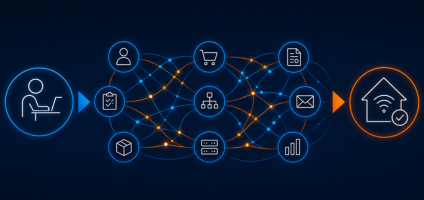
A broadband customer reports an intermittent connection. An AI assistant can summarize the conversation and suggest troubleshooting steps. Resolving the issue, however, may require information from customer records, billing, network monitoring, geographic information systems, and field service.
Each system holds part of the answer. Completing the work requires those systems to exchange information and support coordinated actions.
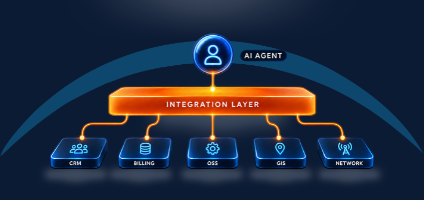
AI agents in telecom need an integration layer that gives them access to relevant operational data and approved actions across OSS, BSS, and network platforms. That layer translates information between systems, supports coordinated workflows, and returns results the agent can verify.
For broadband providers evaluating agentic AI, this makes system integration a practical starting point.
What is agentic AI in telecom?
Agentic AI describes AI systems that can use tools, choose steps toward a goal, and adjust their approach based on results. In telecom, a potential application is investigating a service issue, gathering relevant evidence, and initiating an approved workflow.
The distinction matters operationally. Answering “What could cause this problem?” requires different capabilities from carrying out “Investigate this subscriber’s connection and open the appropriate service request.”
The second task requires access to business and network systems. Tool interfaces provide that access: Anthropic’s engineering guidance, for example, describes tools as the mechanism agents use to interact with external services and APIs.
An agent’s usefulness therefore depends partly on which systems it can reach, what information those systems return, and which actions it is authorized to request.
Why do telecom AI agents need an integration layer?
Broadband operations span customer relationship management (CRM), billing, operations support systems (OSS), business support systems (BSS), geographic information systems (GIS), workforce management, inventory, and network platforms.
Those applications often describe the same customer or service differently. A customer account number in billing may need to be matched to a service identifier in OSS and a device identifier in the network.
An integration layer connects those records and exposes usable operational functions. Depending on the architecture, those functions might retrieve service status, check equipment availability, create a work order, or submit an approved provisioning request.
Without that connection, an agent may produce a plausible recommendation while lacking the information or access needed to complete the task.
This does not mean every agent needs access to every platform. Access should follow the specific workflow and the minimum permissions it requires.
How an integrated AI workflow could support service troubleshooting
Consider an illustrative workflow for a subscriber reporting repeated service interruptions.
- Establish the customer and service context. Retrieve the account, subscribed service, service address, and associated equipment.
- Check relevant network conditions. Request current device status and recent alarms, with timestamps that show how fresh the information is.
- Add geographic context. Use GIS relationships to help determine whether the affected service shares infrastructure with other reported issues.
- Choose the permitted next step. Apply the operator’s rules to recommend further investigation, request approval for an action, or initiate an eligible workflow.
- Record and verify the outcome. Update the service record, capture the action result, and escalate incomplete or uncertain outcomes.
Its value illustrates the architectural requirement: information must remain connected as the task moves between applications. The agent also needs confirmation of what actually happened. A submitted request is not necessarily a completed action.
What should an integration layer provide for agentic AI?
Consistent customer and service context
The integration layer should map identifiers and translate data formats so a workflow acts on the correct account, service, location, and device.
It should also preserve data quality signals. Missing values, conflicting records, and stale telemetry need to remain visible. An agent should be able to recognize when the available evidence is insufficient.
Defined actions with clear permissions
Useful tool interfaces describe exactly what an action does, which inputs it needs, and what its response means.
Reading an account and changing a service are different privileges. Authentication, authorization, and input validation should be enforced by the surrounding systems, independently of the agent’s interpretation of its instructions.
Higher impact actions may require human approval. The integration layer supports the execution path; the wider architecture must supply the appropriate identity, security, and approval controls.
Reliable workflows across multiple systems
Operational tasks can involve several dependent steps. A service change might require validating an order, checking inventory, submitting a network request, and updating billing after confirmation.
A reliable integration design needs defined behavior when one step fails. That includes timeouts, safe retries, duplicate prevention, and escalation. Where appropriate, it also needs a way to reverse or compensate for earlier changes.
Otherwise, a partial failure can leave applications describing different versions of the same service.
Observable results
Operators need visibility into the systems contacted, actions requested, responses received, and final workflow status.
That record helps teams investigate exceptions and distinguish an agent’s reasoning from a verified operational result. It also provides evidence for evaluating whether the workflow is ready for broader use.
Integration is necessary for many operational AI use cases, but it does not by itself guarantee accurate reasoning or safe execution.
Can broadband providers use existing systems for agentic AI?
Often, providers can begin with existing platforms if those systems expose suitable APIs or can be connected through supported adapters or middleware.
The practical question is whether the systems involved in a selected workflow can provide reliable data and accept controlled requests.
A legacy platform may require an API wrapper, additional validation, or limits on which functions are exposed. Some systems may remain unsuitable for automated actions until those gaps are addressed.
This gives operators a way to assess modernization around a concrete operational need rather than treating an entire technology replacement as a prerequisite for every AI initiative.
Where Intelegrate Connect fits
ETI’s Intelegrate Connect is a low-code integration engine built for telecom and broadband service providers. It integrates OSS, BSS, network devices, and data sources through an interoperability layer and supports workflow automation.
That integration role is relevant to AI readiness. Connecting operational systems can help establish the data exchange and execution paths an AI application would need to use.
The agent, its reasoning, and the policies governing its behavior remain separate architectural considerations. Providers still need to define approved actions, security controls, evaluation criteria, and human oversight for each use case.
How should an ISP start preparing for AI agents?
Start with one bounded workflow where system handoffs create measurable friction.
Map the applications involved, identify the authoritative source for each data element, and define the actions the workflow may request. Establish what counts as success and what should trigger escalation.
A sensible rollout can begin with information gathering and recommendations. Teams can then introduce approved actions as testing demonstrates reliable behavior.
Measure operational outcomes such as resolution time, manual handoffs, record accuracy, and exception rates. Those measures provide a stronger basis for expansion than the number of agents deployed.
The first question is which operational task needs to work better—and whether the systems behind it can reliably work together.
Frequently asked questions
What is an integration layer in telecom?
An integration layer connects business applications, operational systems, and network platforms so they can exchange data and participate in coordinated workflows. It can translate formats, map identifiers, and expose defined functions across different technologies.
How is an integration layer different from an AI agent?
An AI agent selects steps and uses tools to pursue a goal. An integration layer provides connections and operational functions those tools can use. Integration does not itself supply the agent’s reasoning.
Does giving an AI agent access to a database enable telecom automation?
Database access can support information retrieval, but operational automation also requires authorized action interfaces, workflow rules, error handling, and confirmation from the systems carrying out the work.
Do broadband providers need to replace their OSS and BSS before using AI agents?
Not necessarily. Existing systems may support a defined AI workflow through APIs, adapters, or middleware. Readiness depends on data quality, accessible functions, security controls, and the reliability of the underlying process.
© 2026 Enhanced Telecommunications.