This article was inspired in part by a recent LinkedIn post from David Tidd, ETI’s VP of Engineering, exploring synchronous and asynchronous integration patterns in telecom. His framework raised a broader question for us: What actually happens across the enterprise after a customer places an order?
A customer visits a broadband provider’s website, checks service availability, selects a plan and clicks “Order.”
To the customer, it’s one transaction.
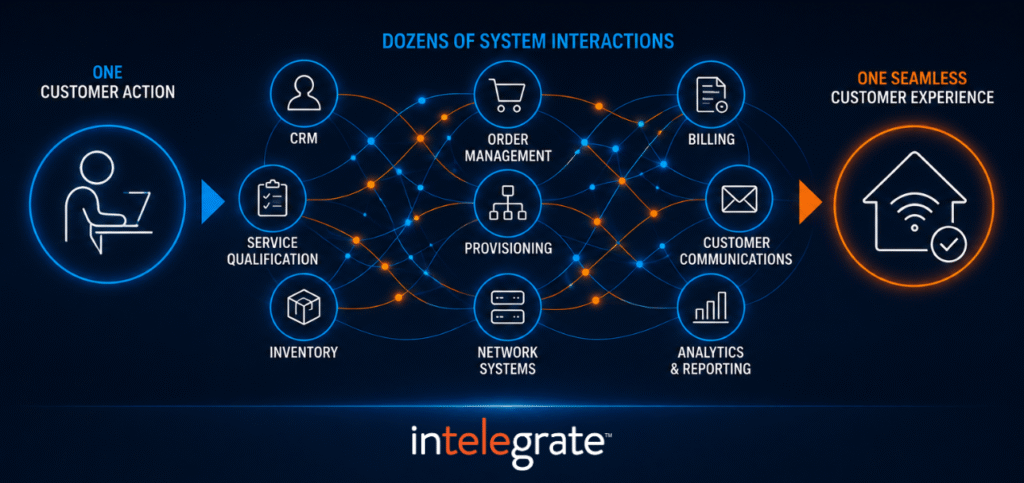
Behind the scenes, that single broadband order can trigger dozens of interactions across CRM, service qualification, order management, inventory, OSS/BSS platforms, network provisioning, billing and customer communications.
Some of those interactions need to happen immediately. Others happen in the background. Some depend on another process being completed first. And increasingly, they involve applications and network infrastructure from multiple vendors.
This is the reality of modern broadband operations—and why telecom integration is about much more than connecting one system to another.
It requires orchestration across the entire service lifecycle.
What Happens After a Customer Places a Broadband Order?
Consider what happens when a prospective customer enters an address to determine whether broadband service is available.
They expect an immediate answer.
Behind that request, systems may need to check serviceability data, network availability, product eligibility and pricing before responding.
Once the customer places the order, an entirely different series of processes begins.
The order may need to move through:
- Customer and order management
- Inventory and service qualification
- OSS/BSS systems
- Network and device provisioning
- Installation or field service
- Billing
- Customer notifications
These activities don’t necessarily happen at the same time or in a simple sequence.
Some processes require real-time responses. Others can run independently in the background. One process may trigger several others, while another may have to wait for a specific event before continuing.
Yet to the customer, they’re all part of one experience.
That’s an important distinction because not every telecom integration should behave the same way.
What Is Telecom Integration?
Telecom integration is the process of connecting the applications, data, network systems and workflows required to operate and deliver communications services.
For broadband providers, that can include CRM, BSS, OSS, billing, order management, inventory, provisioning, network management, GIS and customer-facing applications.
Traditionally, integration projects have often focused on establishing connections between individual systems.
But connecting systems is only part of the challenge.
The larger question is whether those systems can work together effectively to complete an end-to-end business process.
Start With the Business Process, Not the Technology
Integration conversations frequently begin with technology.
Which APIs are available? What middleware should we use? Should the architecture be event-driven? How should one platform connect to another?
Those are important questions, but they shouldn’t necessarily be the first ones.
Start with:
- What needs to happen?
- Does another system need information immediately before it can continue?
- Can a process run independently?
- Does one action need to trigger several downstream processes?
- What happens if one system is temporarily unavailable?
- Does a process require information from multiple vendors or applications?
Understanding the business interaction first makes it easier to determine the appropriate integration architecture.
This is particularly important in telecom environments, where a single customer or operational process can span CRM, BSS, OSS, network infrastructure, billing and third-party platforms.
Why Is OSS/BSS Integration Important for Broadband Providers?
OSS and BSS platforms perform different but interconnected functions across broadband operations.
BSS platforms typically support customer-facing and commercial processes such as customer management, ordering and billing, while OSS platforms support operational functions such as service fulfillment, provisioning, inventory and network operations.
But customers don’t experience these as separate systems.
A service order may begin in the BSS environment and ultimately require actions across OSS platforms, network infrastructure and billing systems before service can be successfully activated.
When those systems don’t communicate effectively, providers can encounter:
- Manual data entry and swivel-chair operations
- Provisioning delays
- Order fallout
- Inconsistent customer or service data
- Billing errors
- Limited visibility across the service lifecycle
Effective OSS/BSS integration helps information and workflows move across those boundaries more efficiently.
The Challenge Grows as the Telecom Ecosystem Grows
Few broadband providers operate in a single-vendor environment.
Most have a combination of legacy applications that still perform essential functions, newer cloud platforms, network technologies from multiple equipment vendors and specialized systems added over years of growth.
Replacing all of those systems isn’t necessarily practical—or desirable.
The challenge is making them operate as part of a coordinated ecosystem. That’s where interoperability, integration and automation converge.
Systems need to exchange information. Data needs to reach the right application at the right time. Processes need to continue across application boundaries. And operations teams need visibility into what’s happening when something doesn’t go according to plan.
Connecting the applications is only the beginning.
What Is Telecom Orchestration?
Telecom orchestration coordinates the systems, data and automated workflows required to complete an end-to-end operational process or deliver a communications service.
Instead of focusing solely on individual system-to-system connections, orchestration focuses on the larger outcome.
Think again about that broadband order.
- One interaction determines whether service is available.
- Another creates or updates the customer record.
- The order triggers downstream processes.
- Inventory identifies available resources.
- Provisioning configures the appropriate network elements.
- Billing begins at the correct point in the service lifecycle.
- Notifications keep the customer informed.
No single application owns that entire experience. The experience is created by how well all of those applications, systems and processes work together.
That’s the value of orchestration.
It shifts the focus from individual integrations to the business and customer outcome the provider is trying to achieve.
How Do Integration, Automation and Observability Work Together?
Creating a coordinated broadband environment requires three fundamental capabilities:
Connect the Ecosystem
Applications, data, OSS/BSS platforms and network systems need to communicate across vendors, architectures and generations of technology.
Interoperability allows providers to connect legacy and modern systems without requiring every application to come from the same vendor. ETI solves this problem with Intelegrate Connect.
Automate the Work
Once systems can communicate, workflows can move across them with less manual intervention. Automated service provisioning can help streamline processes such as order management, service fulfillment and network provisioning while reducing duplicate data entry and swivel-chair operations.
ETI has been a leader in automation for over 30 years, and continues its innovation through Intelegrate Automate.
Observe the Outcome
Providers also need visibility into what is happening across the network and service environment.
Network observability helps operations teams understand performance, identify problems, recognize dependencies and respond when something doesn’t work as expected.
ETI’s Intelegrate Observe captures this information visually through maps and dashboards.
Connect. Automate. Observe.
Together, these capabilities can turn a collection of individual technologies into a coordinated operational ecosystem. Check Out ETI’s Intelegrate suite of products to learn more.
Does Modernization Require Replacing Existing OSS/BSS Systems?
Not necessarily.
Telecom modernization doesn’t have to mean replacing every existing application or committing to a single-vendor environment.
Providers can preserve systems that continue to deliver value while introducing new platforms, connecting previously siloed data and automating processes incrementally.
A flexible, vendor-agnostic integration approach can provide a bridge between legacy infrastructure and newer technologies.
That allows modernization to happen at a pace aligned with the provider’s operational requirements, resources and business priorities.
Complexity Behind the Scenes. Simplicity for the Customer.
The customer who clicks “Order” will probably never know how many applications, integrations, workflows and network processes were involved in delivering their service.
That’s exactly how it should be.
Customers don’t want to understand the complexity of telecom operations.
They want to know:
- Can I get service?
- When will it be installed?
- Is it working?
- Was I billed correctly?
Delivering those simple outcomes requires considerable sophistication behind the scenes.
The goal, therefore, isn’t simply integration.
It’s creating an environment in which systems, data, workflows and network operations work together across the entire service lifecycle.
Because ultimately, the customer sees one experience.
It’s up to the technology behind it to make that experience work.
Frequently Asked Questions
What is OSS/BSS integration?
OSS/BSS integration connects the business and operational systems used by telecom and broadband providers so that customer, order, service, network and billing information can move across the organization and support end-to-end processes.
What is telecom orchestration?
Telecom orchestration coordinates multiple systems, data sources and automated workflows to complete an operational process, such as qualifying, ordering, provisioning, activating and billing for broadband service.
Why is interoperability important in telecom?
Telecom providers often operate technology from multiple vendors and different generations. Interoperability allows these systems to exchange data and participate in common workflows without requiring providers to replace their entire technology environment.
What is automated service provisioning?
Automated service provisioning uses integrated systems and workflows to configure and activate network services with less manual intervention. It can help providers accelerate service activation, reduce errors and improve operational efficiency.
What’s the difference between integration and orchestration?
Integration enables systems to exchange data and communicate. Orchestration coordinates those integrations and automated processes to accomplish a larger end-to-end business or operational outcome.
© 2026 Enhanced Telecommunications.