The following summary has been condensed for length and readability. To listen to the full discussion, click . This episode is sponsored by and .
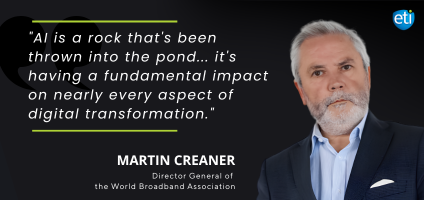
Broadband is entering a new era where fiber infrastructure, artificial intelligence (AI), and digital sovereignty are becoming strategic advantages. In this episode of The Broadband Bunch, Martin Creaner, Director General of the World Broadband Association (WBBA), explains why network operators have an opportunity to move beyond connectivity and become partners in the AI economy.
For years, broadband providers have focused on expanding coverage, increasing speeds, and improving reliability. Those priorities remain essential, but the conversation is changing. AI workloads, cloud computing, and growing concerns around digital sovereignty are creating new demands for high-performance broadband networks.
According to Creaner, operators that invest in fiber, embrace AI strategically, and prepare for agentic technologies will be better positioned to capture new revenue opportunities over the next decade.
Why Fiber Is More Important Than Ever
After decades dominated by mobile innovation, Creaner believes the industry is entering a period where fixed broadband once again becomes the foundation of digital infrastructure.
Emerging technologies such as AI, robotics, cloud computing, immersive applications, and ultra-high-definition video all require reliable, low-latency connectivity. Fiber provides the bandwidth and performance necessary to support these workloads.
While mobile networks continue to play an important role, Creaner argues that the next generation of digital services will depend on high-quality fixed broadband infrastructure.
The World Broadband Association’s Mission
Founded in 2021, the World Broadband Association was created to give the global fixed broadband industry a unified voice similar to what the GSMA provides for the mobile ecosystem.
Today, the WBBA focuses on helping governments, operators, investors, and technology providers understand where broadband is headed through research and industry collaboration.
Its current initiatives include:
- Broadband investment strategies
- Fiber deployment and adoption
- AI and cloud infrastructure
- Sustainability and energy efficiency
- Gaming and emerging broadband applications
- Future network architecture
- Global broadband benchmarking through industry indices
Broadband Investment Is About More Than Building Networks
Creaner explains that fiber remains an attractive long-term investment because infrastructure can deliver value for decades. However, successful investments depend on more than simply deploying fiber.
Investors are increasingly evaluating:
- Market demand and customer adoption
- Network competition
- Public-private partnerships
- Long-term profitability
- Sustainable deployment strategies
In many markets, the challenge isn’t building networks—it’s ensuring enough customers adopt the services to create strong returns on investment.
Measuring Broadband Success Around the World
The WBBA publishes several global indices that help governments and operators evaluate broadband readiness and investment opportunities.
These include:
- Fiber Development Index – Measures fiber deployment, network quality, and adoption across more than 90 countries.
- Broadband and Cloud Development Index – Evaluates broadband infrastructure alongside cloud capabilities.
- Gigacities Index – Ranks cities based on broadband readiness, helping attract businesses and investment.
These benchmarks provide valuable insight into where countries and cities are succeeding—and where additional investment is needed.
AI Is Changing Digital Transformation
Creaner has spent years writing about digital transformation in telecommunications, but he believes AI is fundamentally reshaping that conversation.
Rather than affecting only automation, AI is influencing nearly every aspect of telecommunications, including:
- Network operations
- Security
- Customer engagement
- Workforce development
- Business models
- Data management
- Organizational culture
He argues that telecommunications providers must prepare not only for AI tools but also for an emerging agentic economy, where AI agents complete increasingly complex tasks with minimal human involvement.
Is the AI Industry in a Bubble?
Creaner believes the industry is currently experiencing an AI investment bubble fueled by massive spending on GPUs and data centers before sustainable business models have fully emerged.
Rather than expecting a sudden collapse, he predicts a gradual market correction over the next several years as organizations shift their focus from infrastructure spending to developing profitable AI services. Once stronger business models emerge, investment is likely to accelerate again.
His perspective encourages broadband providers to remain optimistic about AI while making thoughtful, long-term investment decisions.
Why Digital Sovereignty Creates Opportunity for Broadband Providers
As governments and enterprises seek greater control over where data is stored and how AI services are delivered, telecommunications providers are well positioned to become trusted partners.
Creaner believes operators can play a larger role by offering:
- Sovereign cloud services
- Secure AI infrastructure
- Trusted connectivity
- National digital infrastructure partnerships
Rather than competing directly with hyperscale cloud providers, broadband operators may increasingly serve as trusted intermediaries that deliver secure, compliant infrastructure to enterprise customers.
Key Takeaways for Broadband Providers
Creaner leaves operators with three clear priorities:
- Continue investing in high-quality fiber infrastructure.
- Develop a strategy for AI and agentic technologies.
- Prepare for growing demand around digital sovereignty and trusted infrastructure.
These trends are reshaping telecommunications, and operators that act early may be better positioned to lead the next phase of broadband innovation.
Frequently Asked Questions
What is the World Broadband Association (WBBA)?
The World Broadband Association is a global nonprofit organization focused on advancing fixed broadband through research, collaboration, investment guidance, and industry standards.
Why is fiber becoming more important?
Fiber delivers the bandwidth, reliability, and low latency needed to support AI, cloud computing, robotics, gaming, and future digital applications.
What is digital sovereignty?
Digital sovereignty refers to giving governments and organizations greater control over their data, cloud infrastructure, and AI services, often through trusted national or regional providers.
What are agentic AI systems?
Agentic AI refers to AI systems that can make decisions and complete multi-step tasks with limited human intervention, creating new opportunities and challenges for broadband providers.
Why are broadband operators well positioned for AI?
Broadband providers own and operate the infrastructure that AI depends on. As demand grows for secure connectivity, sovereign cloud services, and high-performance fiber networks, operators have an opportunity to expand beyond traditional connectivity services.
© 2026 Enhanced Telecommunications.