The Short Answer: AI agents are software systems that analyze data, make decisions, and complete multi-step tasks across telecom systems with limited human intervention. For telecom operators, they go beyond older rule-based systems by detecting network issues, running provisioning workflows, and supporting customer service in real time. The result is faster operations, fewer manual steps, and better visibility.
For years, automation in telecom meant scripts and fixed rules. That helped, but it could not keep pace as networks grew across access layers, data centers, cloud, and customer applications.
AI agents change what automation can handle. Instead of following one rigid script, an agent works through a complex task, pulls from historical and live data, and decides what to do next. It acts less like a fixed tool and more like a digital assistant for the people running the network.
Below, we cover what AI agents are, how telecom operators use them today, and what your team needs before putting them to work.
What Are AI Agents in Telecom?
An AI agent is a software system that can analyze data, make decisions, and complete tasks across telecom systems with varying levels of autonomy. It can identify a network issue, pull data from multiple systems, run a workflow to fix it, and confirm the result, all with limited human intervention.
AI Agents vs. Traditional Automation
Older automation runs on rule-based systems. An engineer writes a script, and the system follows it exactly. If conditions change or fall outside the rules, the script fails.
AI agents interpret operator intent, choose from several actions, and adjust as conditions change. That flexibility is what separates autonomous agents from a basic script:
- Rule-based systems handle repetitive tasks with fixed inputs and outputs.
- AI agents handle a complex task involving judgment, multiple systems, and changing data.
How AI Agents Work in a Telecom Environment
AI agents depend on access to data. They need to read from OSS and BSS platforms, CRM systems, and network monitoring tools. Open APIs make that possible, moving information between systems instead of working from one isolated source.
Agents pull from two kinds of data: historical data that shows past patterns, and real-time data that shows what the network is doing now. Many rely on large language models, letting staff describe what they need in natural language rather than write code. An orchestration layer coordinates which agent runs which task, the same foundation behind self-healing, autonomous networks.
See AI Agents and Network Automation Are Reshaping Telecom Infrastructure and How to Prepare Your Data for AI Integration.
How AI Agents Are Transforming Telecom Operations
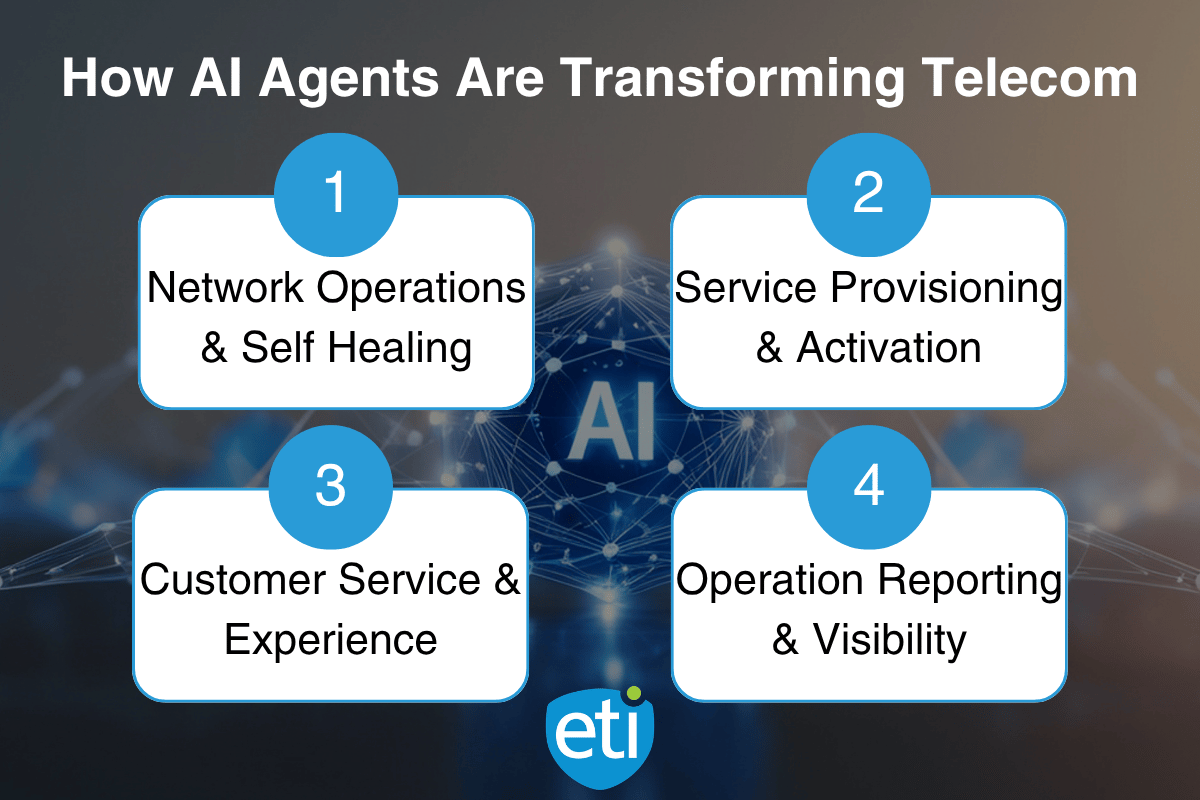
The strongest use cases share a pattern: the agent handles repetitive, multi-step work, and the team gets back time, accuracy, and visibility. Four areas where telecom operators use them today:
1. Network Operations and Self-Healing
AI agents monitor the network, detect a problem, find the likely root cause, run an approved fix, and validate the result. By analyzing network traffic and telemetry as it streams in, an agent spots anomalies a human watching thousands of alerts might miss.
- Capability: Correlate events, isolate the cause, and trigger remediation with minimal human intervention.
- Example: A routing change that once took several engineers a weekend can run through automated workflows in far less time.
- Outcome: Less downtime, fewer manual alerts, faster resolution.
2. Service Provisioning and Activation
Provisioning touches billing, the CRM, and the network. Run by hand, mismatches cause failed activations and rework.
- Capability: Run multi-step provisioning and service activation across connected systems in one workflow.
- Example: An agent confirms the order, configures the service, and updates each system so records agree.
- Outcome: Faster deployment, fewer errors, less manual reconciliation.
ETI’s Intelegrate Automate runs these workflows without manual steps.
3. Customer Service and Customer Experience
When a subscriber calls, the rep needs account details, service status, and recent history fast. AI agents gather that context and summarize the case first.
- Capability: Pull customer research and case summaries from multiple systems automatically.
- Example: An agent compiles the subscriber’s configuration and recent interactions into one view.
- Outcome: Faster resolution, higher customer satisfaction, a smoother user experience on the line.
4. Reporting and Operational Visibility
AI agents assemble data from several systems and build role-specific dashboards for operations, customer service, and leadership.
- Capability: Gather data across systems, generate reports, and assist with validation.
- Example: An agent prepares a regulatory report by collecting the data and checking it before submission.
- Outcome: Time saved, better visibility, consistent reporting.
The same gains reach software development: Rhyan Neble, founder of Extended Systems Intelligence (XSI), describes an OSS/BSS integration that once took 26 people six months, recently completed in roughly one week using agentic AI tools.
| Workflow | Traditional Approach | AI Agent Approach |
| Network issues | Engineers triage alerts and fix manually | Agent detects, diagnoses, and remediates |
| Provisioning | Manual entry across billing, CRM, network | One coordinated, automated workflow |
| Customer service | Rep toggles between systems | Agent delivers a unified case summary |
| Reporting | Staff compile data by hand | Agent assembles dashboards and reports |
What Operators Need Before Deploying AI Agents
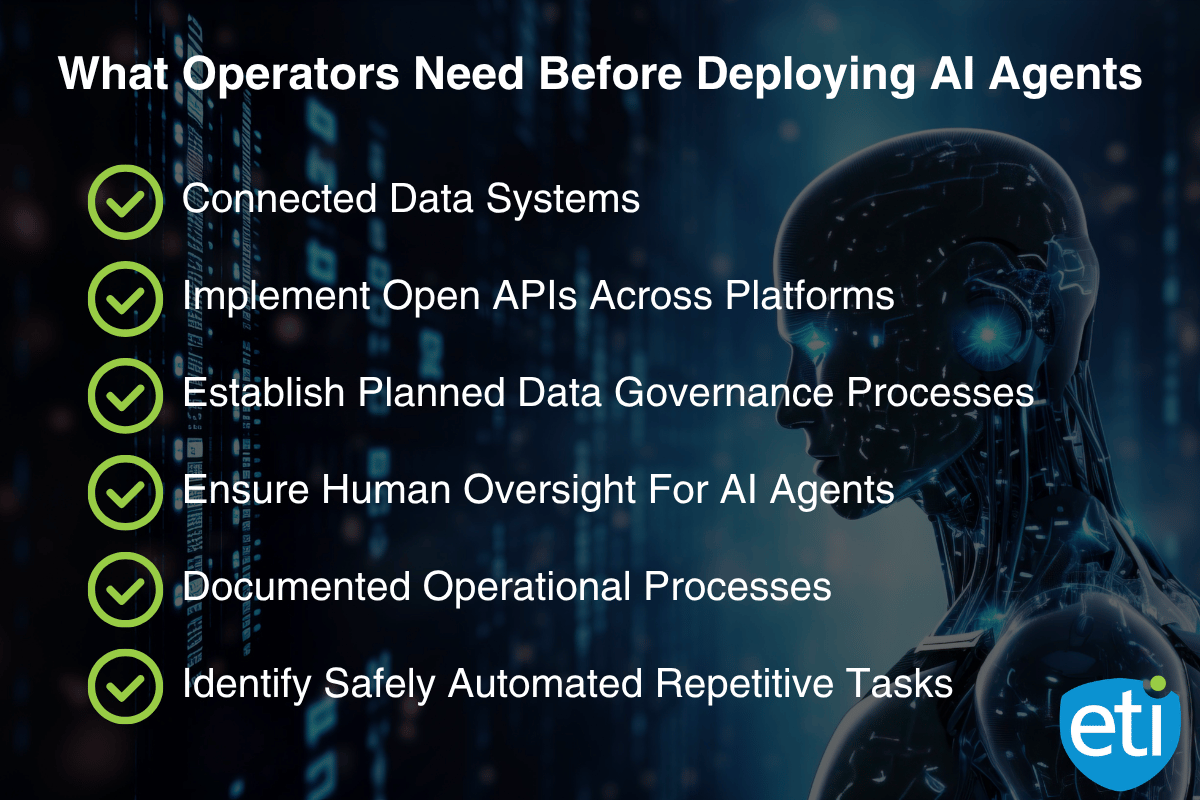
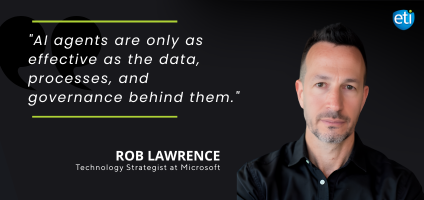
AI agents are only as good as the data and guardrails behind them. Get these right, and agents deliver. Skip them, and the same tools introduce risk.
Connected Data and Open APIs
AI agents perform best when information moves freely between systems. An agent that sees billing data but not the network or CRM works from an incomplete picture.
Open APIs make that access possible, letting agents read from OSS and BSS platforms, field service software, and monitoring tools without manual exports. Operators on closed or legacy systems are at a disadvantage because their data cannot reach the agents that need it. This is where data silos hurt: when records live in separate systems, agents inherit the gaps.
ETI’s Intelegrate Connect ties OSS, BSS, and network systems together to remove data silos and keep your systems running smoothly.
Governance and Human Oversight
Current AI systems still make mistakes. Telecom operators need clear rules for what agents can and cannot do, especially in production networks.
Start agents on low-risk tasks and expand as confidence grows. Many operators use layered oversight, where one agent checks another’s work before any action is taken, mirroring the checks and balances teams already use for human decisions.
A Starting Checklist
- Document your operational processes so agents have clear procedures to follow.
- Open up your systems with APIs that let data move between platforms.
- Identify repetitive tasks that consume staff time and are safe to automate.
- Experiment with AI assistants on small, low-risk workflows.
- Build governance rules before agents are deeply embedded in operations.
These steps lower operational costs over time and give your team a competitive advantage as agentic AI matures across the telecom industry.
Getting Started with AI Agents
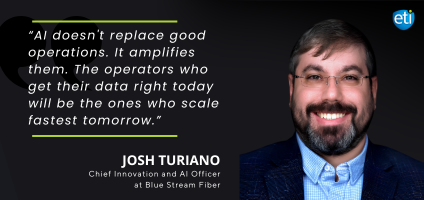
AI agents are moving telecom past fixed scripts and into workflows that detect issues, run provisioning, support customer service, and surface insights in real time. The operators seeing results are not automating everything at once. They start with connected data, clear governance, and a few high-value workflows, then expand as agents prove themselves.
This technological advancement is available now, not years out. Operators who prepare early gain a real competitive advantage as the tools mature.
ETI’s Intelegrate platform gives telecom and broadband providers the foundation AI agents need. Intelegrate Connect ties your OSS, BSS, and network systems together. Intelegrate Observe normalizes device and network telemetry into one view. Intelegrate Automate runs your workflows without manual steps.
Want to see how this fits your environment? Contact ETI to walk through your workflow and integration needs.