The following summary has been condensed for length and readability. To listen to the full discussion, click . This episode is sponsored by and .
Artificial intelligence is evolving quickly, and agentic AI has become one of the industry’s hottest topics. While much of the conversation focuses on increasingly capable AI models, many organizations are overlooking a more important question: Is the business actually ready to deploy autonomous AI agents?
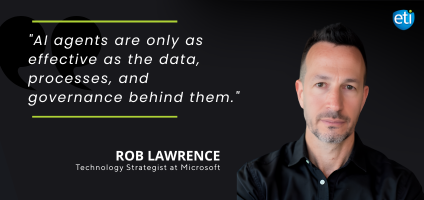
In this episode of The Broadband Bunch, host Pete Pizzutillo welcomes Rob Lawrence, Technology Strategist at Microsoft, to discuss what separates successful AI initiatives from those destined to disappoint. Rather than focusing on the latest models or tools, Lawrence argues that organizations should concentrate on governance, process ownership, data quality, observability, and accountability before allowing AI agents to operate autonomously.
For broadband providers and enterprise technology leaders, the conversation offers a roadmap for responsible AI adoption.
The Biggest Challenge Isn’t the AI Model
Much of today’s AI conversation centers around which large language model performs best. Lawrence believes that’s the wrong place to start.
Instead, organizations should evaluate the environment into which AI agents will be deployed. Every autonomous system depends on clearly defined business processes, reliable data, appropriate permissions, and human oversight. Without those foundations, even the most capable AI models will struggle to deliver consistent business value.
In other words, the success of agentic AI depends less on intelligence and more on operational maturity.
Why AI Pilots Often Succeed—but Production Doesn’t
Pilot projects typically receive constant attention from technical teams, operate within carefully controlled environments, and involve limited business scope. Once AI agents are deployed into production, however, that oversight often disappears.
Without proper monitoring and observability, organizations may have little visibility into what AI agents are doing—or why they’re making certain decisions.
Lawrence compares this to hearing complete silence from another room when children are playing. Sometimes the absence of activity is more concerning than obvious noise.
For AI, observability becomes just as important as automation itself.
Data Governance Is More Important Than Ever
The phrase “garbage in, garbage out” has existed for decades, but Lawrence believes it has never been more relevant.
AI agents act on the data they’re given. If that information is incomplete, inconsistent, or inaccurate, AI can simply make bad decisions much faster than humans.
Broadband providers often maintain information across OSS, BSS, CRM platforms, spreadsheets, and departmental applications. Unless those systems provide trusted, governed data, organizations risk scaling poor decisions instead of improving operations.
Lawrence describes today’s environment as the third major wave of enterprise data governance—one driven not by reporting or dashboards, but by autonomous AI.
Process Ownership Matters Before Automation
Organizations frequently attempt to automate workflows they don’t fully understand. Over time, employees create workarounds, tribal knowledge develops, and unofficial processes emerge outside systems of record.
Before introducing AI agents, leaders should ask simple questions:
- Who owns this process?
- How does work actually get completed?
- Where are decisions really being made?
- Is the documented workflow accurate?
If those questions can’t be answered confidently, automation will likely expose existing organizational weaknesses rather than eliminate them.
Identity and Permissions Become Critical
Unlike traditional software, AI agents actively perform work across multiple applications.
They may read email, update CRM records, schedule appointments, generate reports, or trigger business workflows—all without direct human interaction.
That raises an important governance challenge.
Organizations need clear rules governing what AI agents are allowed to access, what actions they can perform, and whose authority they represent.
Rather than borrowing a user’s permissions, future AI deployments will increasingly require dedicated identities, controlled access rights, and continuous monitoring.
AI Doesn’t Remove Accountability
As organizations adopt agentic AI, one question becomes unavoidable:
Who is responsible when something goes wrong?
Lawrence argues that accountability always remains with people.
AI agents may execute tasks autonomously, but organizations must establish governance models that define ownership, oversight, recovery procedures, and operational controls before deploying them at scale.
Successful AI adoption is ultimately less about replacing employees and more about creating well-managed partnerships between people and intelligent systems.
Where Broadband Providers Should Begin
For broadband operators exploring AI, Lawrence recommends starting with business processes that are:
- Well documented
- Clearly owned
- High volume
- High cost
- Consistently executed
These workflows provide the strongest opportunities for automation while minimizing unnecessary operational risk.
Processes that depend heavily on tribal knowledge or undocumented exceptions should first be standardized before introducing AI.
The Road Ahead
Lawrence expects agentic AI to become an important part of enterprise operations, but he cautions against unrealistic expectations.
Organizations that focus exclusively on AI models may struggle.
Those that invest in governance, clean data, process engineering, observability, and responsible oversight will be far better positioned to capture long-term value.
The technology is advancing rapidly, but successful adoption will ultimately depend on organizational discipline—not just technical capability.
Frequently Asked Questions
What is agentic AI?
Agentic AI refers to AI systems that can independently plan, make decisions, and complete multi-step tasks with minimal human intervention.
Why is data governance important for AI?
AI systems rely entirely on the quality of the information they receive. Poor data leads to inaccurate decisions, making strong data governance essential for reliable AI outcomes.
Why do AI pilots succeed while production deployments struggle?
Pilots operate in controlled environments with close oversight. Production systems introduce greater complexity, broader access, and reduced visibility, making governance and observability much more important.
What should organizations do before deploying AI agents?
Organizations should document business processes, establish clear ownership, improve data quality, define identity and permission models, and implement monitoring before allowing AI agents to operate autonomously.
How can broadband providers prepare for agentic AI?
Broadband providers should begin with well-understood, repeatable operational processes supported by trusted data and strong governance. Establishing these foundations creates a safer path toward enterprise AI adoption.
© 2026 Enhanced Telecommunications.