The following summary has been condensed for length and readability. To listen to the full discussion, click . This episode is sponsored by and .
Artificial intelligence is quickly reshaping broadband and telecom operations. Network automation once focused on reducing manual work through scripting and orchestration. Today, AI agents, natural language interfaces, and autonomous workflows are changing how operators manage infrastructure at scale.
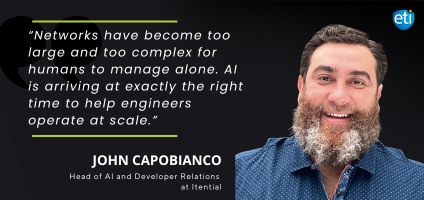
In this episode of The Broadband Bunch, host Pete Pizzutillo speaks with John Capobianco, Head of AI and Developer Relations at Itential, about how AI is transforming network engineering, IT infrastructure, and telecom operations.
Learn why automation is becoming essential for modern networks, how AI agents can reduce operational complexity, and why network engineers need to prepare for a future built around intelligent orchestration.
Network Complexity Is Reaching a Breaking Point
Modern broadband networks are no longer simple environments managed through command line interfaces and manual configuration changes. Service providers now support highly distributed infrastructures spanning access networks, data centers, cloud environments, security systems, and customer applications.
John explains that many operators still rely on traditional workflows that require engineers to manually log into devices, apply configurations, and troubleshoot issues individually. That approach becomes increasingly difficult as networks scale.
Real-world examples in the episode highlight how automation can dramatically reduce operational overhead. John describes a routing update that once required multiple engineers working through an entire weekend. Using automation tools and orchestration workflows, the same process eventually took only minutes to complete.
Automation also reduces the risk of human error, which remains one of the largest causes of outages and service disruptions across telecom and enterprise environments.
Why Network Automation Matters More Than Ever
Broadband providers continue expanding fiber footprints, upgrading infrastructure, and integrating new platforms. Consolidation across the telecom industry adds another layer of operational complexity.
John argues that networks have become too large and dynamic for purely manual operations. AI and automation now serve as force multipliers that help engineers manage infrastructure more effectively.
The episode explains how automation frameworks evolved from basic scripting into full orchestration systems capable of handling large-scale workflows across multiple vendors and platforms. Technologies like Ansible, Python, APIs, and orchestration pipelines laid the groundwork for today’s AI-driven operations.
Artificial intelligence is now accelerating the next phase.
Instead of manually writing every line of code, engineers can increasingly use natural language prompts to generate scripts, workflows, and operational tasks.
AI Agents Are Changing Telecom Operations
John discusses how AI agents can now perform tasks such as:
- Detecting network problems
- Identifying root causes
- Running remediation workflows
- Validating fixes
- Updating documentation
- Managing orchestration tasks
The discussion references real-world examples involving large telecom environments where AI platforms analyze operational data, isolate issues, and trigger automated remediation processes with minimal human intervention.
This concept is often described as a “closed-loop” or “self-healing” network.
Instead of engineers responding manually to thousands of alerts, AI systems can correlate events, determine likely causes, and execute approved workflows automatically.
DIY Automation and Open Source Innovation
John explains how tools like GitHub, open-source models, and model context protocol (MCP) are making advanced automation more accessible to engineers and operators of all sizes.
The conversation highlights John’s open-source project NetClaw, which combines AI agents, network tools, and natural language interfaces to interact with infrastructure systems.
Instead of requiring engineers to memorize complex commands or manually navigate systems, AI interfaces can increasingly interact with infrastructure using conversational prompts.
Examples discussed in the episode include:
- Creating reports through natural language
- Querying operational systems
- Managing network inventories
- Interacting with APIs
- Automating infrastructure tasks
This shift lowers barriers for engineers who may not have traditional software development backgrounds.
Trust, Governance, and Guardrails
AI systems interacting with production networks require clear guardrails, operational policies, and governance frameworks.
John explains that AI agents should initially focus on low-risk tasks such as:
- Documentation validation
- Read-only operational checks
- Inventory reconciliation
- Monitoring workflows
Organizations can gradually expand capabilities as confidence grows.
The episode also explains how AI constitutions, operational rules, and policy-driven constraints can help prevent unsafe actions inside production environments.
Will AI Replace Network Engineers?
John takes an optimistic view, arguing that engineers who understand infrastructure, workflows, and automation strategy may become even more valuable as AI adoption expands.
Automation often shifts engineers toward higher-level responsibilities instead of replacing them entirely. AI also has the potential to reduce burnout by eliminating repetitive operational work and allowing teams to focus on strategic initiatives.
AI Strategy Starts with Leadership
John emphasizes that broadband providers need executive-level AI strategies that include:
- Acceptable use policies
- Governance frameworks
- Security guidelines
- AI access management
- Employee enablement
He also encourages engineers and technical teams to begin experimenting with AI tools directly. Small projects and simple workflows often provide the fastest path toward learning and operational value.
People Frequently Ask
How is AI being used in telecom networks?
AI is increasingly being used for network automation, fault detection, root cause analysis, predictive operations, orchestration, and autonomous remediation. Telecom providers are using AI to reduce outages, improve operational efficiency, and automate repetitive engineering tasks.
What is network automation?
Network automation uses software, scripts, APIs, and orchestration tools to automate network configuration, monitoring, testing, and operational workflows. Automation reduces manual effort and minimizes the risk of human error.
What are AI agents in networking?
AI agents are software systems capable of analyzing data, making decisions, and executing operational tasks autonomously. In networking, AI agents can identify issues, run remediation workflows, update configurations, and validate results.
What is a self-healing network?
A self-healing network uses automation and AI to detect problems, identify root causes, and automatically restore services without requiring manual intervention from engineers.
What is MCP in AI and networking?
Model Context Protocol (MCP) is a framework that allows AI systems to interact with external tools, platforms, APIs, and infrastructure systems using natural language workflows and structured integrations.
Will AI replace network engineers?
AI will likely change how network engineers work rather than fully replace them. Engineers who understand automation, orchestration, and AI governance may become increasingly valuable as networks continue growing in complexity.
Q&A
Why are broadband providers investing more heavily in AI and automation?
Broadband networks continue growing in scale and complexity. Manual operations no longer provide the speed, reliability, or visibility required to manage modern infrastructure efficiently. AI and automation help providers reduce operational overhead while improving service reliability.
How can smaller telecom operators start using AI?
John recommends starting with small, low-risk projects such as documentation validation, reporting workflows, or inventory management. Teams can gradually expand automation initiatives as confidence and operational maturity increase.
What makes AI-driven orchestration different from traditional scripting?
Traditional scripting often requires engineers to manually write and maintain code. AI-driven orchestration allows engineers to use natural language prompts and intelligent workflows to automate tasks more dynamically and efficiently.
Why is governance important for AI in telecom?
AI systems operating in production environments require clear guardrails and operational policies. Governance helps prevent unsafe actions, ensures compliance, and creates trust around autonomous workflows.
What skills should network engineers focus on next?
Engineers should focus on automation, APIs, orchestration platforms, AI-assisted workflows, and operational strategy. Familiarity with AI tools and natural language interfaces will likely become increasingly important across telecom operations.
Final Thoughts
AI continues moving quickly across broadband and telecom infrastructure. Natural language interfaces, autonomous workflows, AI agents, and orchestration platforms are beginning to redefine how networks operate.
This episode of The Broadband Bunch offers a look at how those changes are already happening today—and where the industry may be headed next.
For broadband providers, network engineers, and operations leaders, the message is clear: automation is no longer optional, and AI is rapidly becoming part of the operational foundation for modern networks.