The following summary has been condensed for length and readability. To listen to the full discussion, click . This episode is sponsored by and .
The broadband industry has spent the last two years talking about artificial intelligence. Few providers, however, are applying it in practical ways that create measurable business value.
In this episode of The Broadband Bunch, Pete Pizzutillo speaks with John Hill from GVTC about how AI is already reshaping telecom operations, customer analytics, forecasting, and internal workflows inside a growing fiber broadband provider.
They discuss more than just the generic AI hype and focus on something broadband operators urgently need right now: practical adoption.
How John Hill Entered the Broadband Industry
John Hill did not enter telecom through engineering or network operations. His background started in market research with Nielsen before he transitioned into broadband through GVTC in Central Texas. Over the last decade, he has watched GVTC evolve from a rural telecom provider into a fast growing suburban fiber operator.
During that transformation, GVTC expanded from roughly 55,000 rooftops passed to more than 105,000. At the same time, the company increased fiber coverage from around 50% to more than 90%.
That rapid growth forced the company to think differently about customer analytics, forecasting, competition, and digital operations.
Today, Hill oversees e-commerce, communications, paid advertising, social media, customer analytics, and AI experimentation inside the organization.
Why AI Adoption in Telecom Still Feels Slow
Hill explains that while many vendors and operators discuss AI publicly, practical implementation across the broadband industry remains limited. Most providers still operate with legacy systems, fragmented workflows, and manually entered customer data.
That creates a major challenge because AI systems rely heavily on structured, accessible, high-quality data.
Hill argues that telecom providers cannot expect meaningful AI outcomes while operating with disconnected systems and inconsistent data practices. Many broadband operators still rely on manual processes inside billing systems, OSS/BSS platforms, and customer service workflows.
Without fixing those foundational issues, AI becomes difficult to scale.
The discussion also highlights a broader issue across telecom: organizational culture.
According to Hill, companies that treat AI as a top-down corporate initiative often struggle to gain momentum. Instead, GVTC is encouraging employees to experiment organically with AI tools and share successful use cases internally.
That approach creates faster adoption and stronger engagement across departments.
How GVTC Is Using AI Today
The episode provides several real-world examples of AI use inside GVTC.
Hill describes how his AI journey started with early versions of ChatGPT before moving into more advanced AI workflows using Claude Code and terminal-based AI tools.
Those tools allowed him to work directly with datasets, automate forecasting models, and create customer analytics processes that previously required months of manual work.
One example involved customer churn analysis.
Using anonymized customer data, Hill built AI-assisted models to identify patterns in customer turnover, growth trends, and rental property behavior across GVTC’s footprint.
The results dramatically accelerated analysis timelines.
Forecasting models that previously consumed months of spreadsheet work were completed in just days with improved performance and continuous back-testing capabilities.
The AI tools also surfaced insights that traditional reporting methods failed to identify.
One notable discovery involved identifying likely rental properties based on customer turnover behavior at specific addresses. That insight helped GVTC rethink customer retention strategies and product packaging approaches for transient households.
Why Curiosity Matters More Than Technical Expertise
Hill repeatedly emphasizes curiosity as the most important trait for employees entering the AI era.
He explains that modern AI tools dramatically lower technical barriers by helping users create software, dashboards, forecasts, and workflows without traditional coding expertise.
At GVTC, employees across departments are experimenting with AI in different ways.
Some use terminal-based tools like Claude Code. Others rely on AI agents and visual interfaces to automate web development, dashboards, and internal workflows.
The key is giving employees permission to experiment safely while encouraging them to share lessons learned.
Hill also credits GVTC leadership for creating an environment that supports exploration instead of restricting innovation out of fear.
The Growing Importance of AI in Broadband Competition
The broadband market is becoming significantly more competitive.
Fiber overbuilds, BEAD funding, fixed wireless expansion, and aggressive national providers are forcing operators to rethink how they compete.
Hill believes AI can help smaller and mid-sized broadband providers compete more effectively against larger organizations with massive analytics teams.
Large telecom operators often employ full teams of data scientists.
Many regional providers do not have those resources.
AI changes that equation by giving smaller operators access to advanced analytics capabilities without requiring massive staffing investments.
Hill describes AI as “having a data scientist in your pocket.”
That capability becomes increasingly important as providers try to improve customer retention, optimize growth strategies, reduce churn, and personalize service offerings.
AI and Telecom Culture Change
Hill acknowledges that many employees fear AI could disrupt jobs or eliminate roles entirely.
At the same time, he argues that resisting AI adoption creates even greater long-term risk.
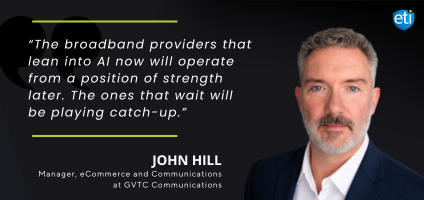
According to Hill, the companies that embrace AI experimentation today will operate from a position of strength in the future. Operators that delay adoption may struggle to remain competitive as the industry evolves.
He compares today’s AI shift to previous generations of digital transformation inside telecom.
The difference is speed.
AI capabilities are evolving rapidly, and the gap between early adopters and hesitant organizations is widening quickly.
Why Broadband Providers Need to Start Now
Hill encourages broadband operators to begin experimenting with AI immediately, even through small internal projects or lightweight automation use cases.
He points to customer service automation, outage messaging, forecasting, analytics, and workflow optimization as low-risk starting points.
The longer organizations wait, the harder it becomes to catch up.
AI is already reshaping software development, operations, marketing, and customer engagement across industries. Broadband providers that build AI-ready cultures now will be better positioned for the next phase of telecom competition.
People Frequently Ask
How are broadband providers using AI today?
Broadband providers are using AI for customer analytics, churn prediction, forecasting, workflow automation, customer service messaging, network optimization, and operational reporting.
What AI tools are telecom companies using?
The episode discusses tools such as ChatGPT, Claude Code, terminal-based AI workflows, AI agents, and automation tools that help employees analyze data and build internal workflows.
Why is AI important for fiber broadband providers?
AI helps broadband providers operate more efficiently, improve customer retention, accelerate analysis, automate repetitive work, and compete more effectively in crowded fiber markets.
What challenges slow AI adoption in telecom?
Legacy systems, fragmented data, cultural resistance, privacy concerns, and inconsistent internal workflows all create barriers to AI implementation.
Can smaller ISPs compete with larger operators using AI?
Yes. AI gives smaller providers access to advanced analytics and automation capabilities that were previously only available to organizations with large data science teams.
Q&A
Q: How is AI changing the broadband industry?
A: AI is helping broadband providers improve forecasting, customer analytics, operational efficiency, customer retention, and workflow automation. Providers are using AI to process large amounts of customer and network data faster than traditional methods.
Q: What makes AI adoption difficult for telecom providers?
A: Legacy systems, disconnected data sources, manual workflows, and cultural resistance remain major obstacles. Many providers still rely on outdated operational processes that make structured AI implementation more difficult.
Q: What AI tools does John Hill discuss in the episode?
A: John discusses using ChatGPT, Claude Code, AI agents, terminal-based AI workflows, and custom analytics projects built around customer and operational data.
Q: How is GVTC using AI in practical ways?
A: GVTC is using AI for customer churn analysis, forecasting, customer growth modeling, workflow automation, and operational analytics. AI helped reduce forecasting projects that once took months down to just a few days.
Q: Why does John Hill emphasize curiosity so much?
A: John believes curiosity is the most important trait for successful AI adoption. Employees who experiment with AI tools and explore practical use cases are learning faster and creating more value for their organizations.
Q: Can smaller broadband providers benefit from AI?
A: Yes. AI allows smaller and regional broadband providers to access analytics and automation capabilities that previously required large teams of data scientists and developers.
Q: What role does company culture play in AI adoption?
A: Company culture plays a major role. Organizations that encourage experimentation, collaboration, and learning are more likely to succeed with AI initiatives than companies relying solely on rigid top-down mandates.
Q: How can broadband operators get started with AI?
A: The episode recommends starting small with practical use cases like customer service automation, forecasting, reporting, and analytics. The key is to begin experimenting now instead of waiting for a perfect long-term strategy.
Final Thoughts
This episode of The Broadband Bunch offers one of the most practical conversations yet about AI adoption inside the broadband industry.
Instead of focusing on buzzwords, John Hill explains how curiosity, experimentation, and operational problem-solving are helping GVTC build real AI workflows today.
For broadband operators trying to understand where AI fits into telecom operations, customer analytics, and competitive strategy, this episode delivers a grounded roadmap for getting started.
© 2026 Enhanced Telecommunications.