The following summary has been condensed for length and readability. To listen to the full discussion, click . This episode is sponsored by and .
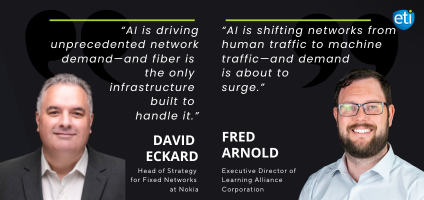
Artificial intelligence is no longer a future concept—it’s actively reshaping how broadband networks are built, scaled, and operated. In this episode of The Broadband Bunch, host Pete Pizzutillo is joined by David Eckard of Nokia and Fred Arnold of Learning Alliance Corporation to break down what AI really means for fiber infrastructure, network strategy, and the broader telecom ecosystem.
The core takeaway is simple but significant: AI is a structural shift, not a feature upgrade. As hyperscale data centers evolve into “AI factories,” demand for fiber capacity is accelerating at an unprecedented pace. These environments require massive interconnectivity, ultra-low latency, and scalable bandwidth. At the same time, AI workloads are moving beyond centralized data centers and pushing toward the edge—into homes, devices, and field operations—creating a more distributed, always-on network environment.
Why AI Is Driving Fiber Demand
AI workloads behave very differently than traditional internet traffic. Instead of simple downloads, streaming, or web browsing, AI introduces:
- Continuous, real-time data exchanges
- High-frequency, small packet transactions (API-driven traffic)
- Increased upstream demand from content creation and AI interactions
- Autonomous systems communicating with each other (“agents talking to agents”)
This shift creates exponential pressure on fiber networks, especially in areas like latency, jitter, and symmetrical bandwidth. Networks built for downstream-heavy consumption must now support bi-directional, real-time intelligence.
David Eckard highlights how modern AI data centers have evolved from a handful of fiber connections to tens of thousands of fiber interconnects, moving data between GPU clusters at incredible speeds. This level of scale simply cannot be supported without robust fiber infrastructure.
AI vs Traditional Network Traffic
Understanding the difference between traditional and AI-driven traffic is critical for broadband providers:
| Traditional Traffic |
AI-Driven Traffic |
| User-initiated (click, stream, download) |
System-initiated (automated, continuous) |
| Burst-based usage |
Constant, persistent activity |
| Downstream-heavy |
Symmetrical (upload + download) |
| Human-paced |
Machine-speed (milliseconds) |
| App-based interaction |
API and agent-based interaction |
AI transforms the network from a content delivery system into a real-time decision engine. That means more compute, more coordination, and significantly more data movement across fiber networks.
Real-World AI Use Cases in Broadband
Fred Arnold brings a practical lens to the conversation, outlining how AI is already being used across telecom environments:
1. Autonomous Provisioning
AI enables faster service activation and reduces manual configuration errors, improving operational efficiency.
2. Predictive Maintenance
Networks can detect and resolve issues before customers experience outages, reducing downtime and truck rolls.
3. Field Service Optimization
Technicians can use AI-driven insights to diagnose issues in real time, improving first-time fix rates and safety outcomes.
4. Customer Experience Automation
AI analyzes customer interactions, call transcripts, and service data to improve support quality and response times.
5. Workforce Training and Development
Organizations like Learning Alliance are using AI labs and LLMs to train the next generation of telecom professionals faster and more effectively.
These use cases demonstrate that AI is not theoretical—it is already delivering measurable value across the broadband ecosystem.
The Rise of Distributed AI and Edge Computing
One of the most important shifts discussed in the episode is the move from centralized AI to distributed AI architectures.
Traditionally, networks followed a simple model:
User → ISP → Internet → Data Center → Response
AI introduces a new model:
User → Edge Compute → Regional Compute → Centralized Training → Orchestrated Response
This distributed approach enables:
- Faster response times
- Reduced latency
- More efficient data processing
- Real-time decision-making closer to the user
However, it also increases the complexity of network design. Data centers are no longer just endpoints—they are becoming coordination hubs in a broader AI ecosystem.
The Role of FBA in AI and Broadband
The Fiber Broadband Association (FBA) launched its AI Committee to help the industry navigate this transformation. The committee focuses on:
- Education and awareness of AI technologies
- Use case development for operators
- Best practices and standards
- Security considerations for AI deployment
- Policy and infrastructure alignment
As AI adoption accelerates, organizations like FBA play a critical role in ensuring that broadband providers are prepared—not just technologically, but strategically.
Infrastructure Challenges Powering AI Growth
AI is not just a network challenge—it’s an infrastructure challenge. Key constraints include:
Power Availability
AI data centers consume enormous amounts of energy. Power generation and distribution are becoming major bottlenecks.
Permitting and Deployment
Fiber expansion still faces delays due to permitting, rights-of-way, and regulatory hurdles.
Water and Cooling
Large-scale AI facilities require significant water resources for cooling systems.
Rural Infrastructure Gaps
Many regions lack the fiber density needed to support AI workloads, creating a risk of digital inequality.
David Eckard emphasizes that this is not just an operator issue—it’s a national and global competitiveness challenge.
What Happens If Providers Don’t Prepare for AI?
Broadband providers who fail to plan for AI-driven demand risk:
- Network congestion and performance degradation
- Higher operational costs due to inefficiencies
- Loss of competitive advantage
- Inability to support emerging applications and services
AI is accelerating faster than previous technology waves. Providers that wait too long may find themselves playing catch-up in a market that rewards early infrastructure investment.
Key Takeaways for Broadband Operators
To stay ahead, operators should focus on:
- Education first: Understand AI fundamentals and capabilities
- Model peak demand: Plan for unpredictable, high-volume traffic patterns
- Design for distribution: Build networks that support edge and regional compute
- Invest in fiber: Ensure scalability for future applications
- Coordinate with utilities: Align with power and infrastructure planning
- Rethink architecture: Move from endpoint-based to ecosystem-based network design
People Also Ask
What is the role of fiber in AI infrastructure?
Fiber provides the high-speed, low-latency connectivity required to move massive amounts of data between AI systems, data centers, and edge devices.
How does AI impact broadband networks?
AI increases bandwidth demand, introduces real-time traffic patterns, and requires more symmetrical and low-latency connections.
What are AI “factories”?
AI factories are large-scale data centers designed to train and run AI models using high-performance computing and massive fiber connectivity.
What is distributed AI?
Distributed AI processes data across multiple locations, including edge devices and regional data centers, rather than relying on a single centralized system.
Why is edge computing important for AI?
Edge computing reduces latency by processing data closer to the user, enabling real-time applications like autonomous systems and smart devices.
Frequently Asked Questions
What should broadband providers do to prepare for AI?
Providers should invest in fiber, plan for distributed traffic, model network demand, and educate teams on AI technologies.
Is AI just hype in telecom?
No. AI is already being used for automation, analytics, and customer experience improvements, with adoption continuing to grow.
Will AI increase internet speeds?
Not directly, but it will drive infrastructure upgrades that improve performance, reliability, and latency.
How does AI affect upstream bandwidth?
AI increases upstream demand due to content creation, data sharing, and continuous interaction with AI systems.
What are the biggest challenges with AI deployment?
Challenges include power constraints, infrastructure costs, network capacity, security risks, and workforce readiness.
Final Thoughts
AI is redefining how networks are built, how data flows, and how services are delivered. The transition from centralized computing to distributed intelligence is already underway, and fiber is the foundation that makes it possible.
For broadband providers, the opportunity is massive—but so is the urgency. Those who invest in infrastructure, education, and strategic planning today will be best positioned to lead in the next era of connectivity.
AI is not a trend. It’s the next phase of the internet—and fiber is what will power it.