The following summary has been condensed for length and readability. To listen to the full discussion, click . This episode is sponsored by and .
In this episode of The Broadband Bunch, host Pete Pizzutillo speaks with Rhyan Neble about one of the most significant technology shifts facing the broadband industry: the rise of agentic AI.
Drawing on nearly two decades of experience building telecommunications networks, OSS/BSS platforms, and software systems, Neble explains how AI has evolved from a simple conversational tool into a workforce multiplier capable of completing complex tasks, coordinating workflows, and accelerating innovation. He argues that broadband operators are entering a new era where AI agents can act as digital assistants for every employee, helping organizations accomplish more without replacing the people who run them.
Rather than focusing on AI as a future possibility, Neble emphasizes that many of these capabilities are available today. Organizations that begin preparing now—through better data integration, open APIs, and operational documentation—will be positioned to gain a significant competitive advantage.
From Six Months to One Week: AI’s Impact on Software Development
Neble compares a large OSS/BSS integration project completed years ago that required a team of 26 people working for six months against a similar project completed recently using agentic AI tools. The newer effort was integrated, tested, validated, and compliance-checked in roughly one week.
According to Neble, AI agents are capable of performing many of the repetitive tasks that traditionally consume development teams, including:
- API integration
- Regression testing
- Code validation
- Documentation review
- Compliance verification
- Workflow automation
The result is not the elimination of software developers but a dramatic increase in productivity. Human expertise remains essential for planning, governance, and oversight, while AI handles much of the repetitive execution.
Human Language Is Becoming the New Programming Language
Neble explains that modern AI systems allow non-technical users to describe business outcomes rather than write code. Customer service leaders, field operations managers, marketing teams, and executives can increasingly build dashboards, automate workflows, and analyze data through conversational instructions.
This shift lowers the barrier to innovation and enables subject matter experts—not just developers—to create solutions tailored to their operational needs.
For broadband providers, this could mean building customized reporting systems, performance dashboards, or workflow automation tools without lengthy development cycles.
Why Open APIs Matter More Than Ever
As AI agents become more capable, they need access to data and systems across the organization. Open APIs make it possible for agents to connect OSS platforms, BSS applications, CRM systems, field service software, network monitoring tools, email platforms, and business intelligence solutions.
Organizations operating closed or proprietary environments may find themselves at a disadvantage because AI performs best when information can move freely between systems.
Neble argues that providers do not need to complete every integration immediately, but they should ensure their systems are capable of supporting future AI-driven workflows.
AI Assistants for Every Employee
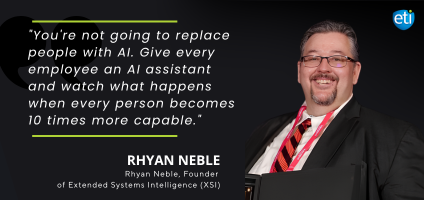
A major theme throughout the discussion is augmentation rather than replacement. Neble rejects the idea that organizations should replace workers with AI. Instead, he believes every employee should have access to an AI assistant that helps eliminate repetitive tasks and increases productivity.
Examples include:
- Customer service representatives receiving automated research and case summaries
- Field service managers gaining real-time operational dashboards
- Marketing teams automating reporting and content preparation
- Network operations teams identifying patterns and anomalies faster
- Executives receiving continuously updated business intelligence
According to Neble, the most successful organizations will be those that treat AI as a collaborator rather than a replacement for human expertise.
AI and Broadband Operations: Practical Use Cases
Regulatory Reporting
Tasks such as FCC reporting often require significant manual effort from highly skilled employees. AI agents can analyze regulatory requirements, gather data from multiple systems, generate reports, and assist with validation before submission.
Network Performance Analysis
By combining telemetry data, inventory records, asset management information, and operational metrics, AI can identify patterns that humans may overlook. This could help operators detect firmware issues, recurring service problems, or process inefficiencies.
Operational Dashboards
AI agents can assemble information from multiple business systems and create role-specific dashboards for operations, customer service, sales, marketing, and executive leadership teams.
Workflow Optimization
Organizations can use AI to document and analyze operational procedures, identify bottlenecks, and recommend improvements that increase efficiency and consistency.
Governance, Security, and the Need for AI Oversight
Current AI systems still hallucinate, make mistakes, and occasionally generate incorrect information. To address this challenge, he advocates using multiple agents to verify one another’s work and creating layered oversight structures that reduce risk.
This philosophy forms the foundation of XSI’s AIMS framework, an open initiative designed to establish governance standards for autonomous AI agents.
Rather than relying on a single AI system, Neble recommends creating supervisory layers where agents validate outputs, challenge assumptions, and identify errors before actions are taken. This approach mirrors the checks and balances organizations already use for human decision-making.
The Future of Agentic AI in Broadband
Neble believes the broadband industry is only beginning to understand the impact agentic AI will have on operations, software development, customer experience, and business processes.
His advice to broadband leaders is straightforward:
- Invest in systems with open APIs.
- Document operational processes in detail.
- Identify repetitive tasks that consume employee time.
- Experiment with AI assistants today.
- Build governance frameworks before AI becomes deeply embedded in operations.
Organizations that prepare now will be better positioned to leverage the next generation of AI-driven tools as the technology continues to mature.
Key Takeaway
Agentic AI is rapidly moving beyond simple chatbots and into operational workflows that can automate tasks, accelerate development, surface insights, and support decision-making. According to Rhyan Neble, broadband providers should begin laying the groundwork today by prioritizing interoperability, documenting processes, and exploring how AI assistants can augment every employee. Those that do may gain a significant advantage in efficiency, agility, and innovation as AI adoption accelerates across the industry.
Q&A
What is agentic AI?
Agentic AI refers to AI systems that can perform actions, execute workflows, use tools, access data sources, and complete multi-step tasks with varying levels of autonomy.
How can broadband providers use agentic AI today?
Providers can use agentic AI for reporting, dashboard creation, workflow automation, software development assistance, customer service support, and operational analysis.
Why are open APIs important for AI adoption?
Open APIs allow AI agents to access information across systems, making it easier to automate processes and generate insights from multiple data sources.
Will AI replace broadband employees?
Neble argues that AI should be used to augment employees, not replace them. AI assistants can eliminate repetitive tasks and enable workers to focus on higher-value activities.
What should broadband operators do first?
Start by documenting operational processes, ensuring systems support integration through APIs, and identifying repetitive tasks that could benefit from automation.
© 2026 Enhanced Telecommunications.