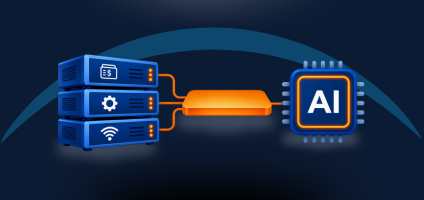
An AI-ready ISP can make reliable operational data and established workflows accessible to AI across its business systems. Building that capability requires dependable connections among platforms, consistent information, and processes that can execute and verify operational tasks.
For many providers, the first obstacle is familiar: customer information lives in one platform, service status in another, and network or location data somewhere else. AI becomes more useful when those systems can exchange information and participate in the same operational process.
For broadband providers, that work can begin with infrastructure already in place. CRM, billing, OSS/BSS, GIS, inventory, and network platforms do not all need to be replaced before an operator can make progress.
This approach informs ETI’s development of Intelegrate: helping broadband providers connect existing systems and improve operational workflows as the build toward AI readiness.
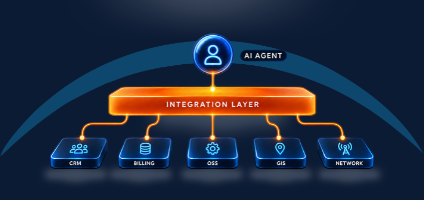
One architectural decision matters early: keep system integration separate from the AI agent. Reusable APIs, adapters, and an integration layer should handle access to operational systems. Agents can use those approved interfaces without becoming the place where every system connection and business rule is built.
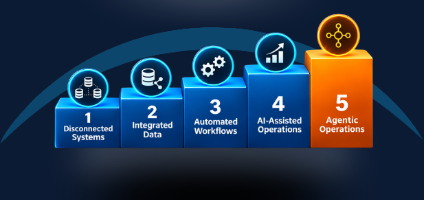
The following five-stage maturity model gives ISPs a practical way to assess that foundation and identify their next investment.
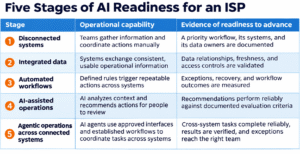
An ISP might be at Stage 3 for service activation, Stage 2 for outage analysis, and Stage 1 for construction handoffs. Each workflow needs its own path forward.
Stage 1: Disconnected Systems
At this stage, employees connect the business through manual effort.
A support representative checks the CRM, opens a network management platform, reviews billing status, and messages another team to understand a subscriber issue. Information exists, but assembling it takes time and depends on individual knowledge.
Capabilities to Build
Start by documenting one operational workflow. Identify the systems involved, the data each contributes, and the decisions employees make between steps.
Establish how customer, service, location, and device records relate. If billing identifies a subscriber one way and the network identifies the associated device another way, that relationship needs to be resolved before downstream analysis can be trusted.
Controls and Organizational Changes
Assign a business owner to the workflow and an owner to each critical data source. Document access permissions and identify sensitive information before creating new connections.
Bring operations, IT, customer care, and relevant business teams into the same discussion. The objective is to agree on how the process should work and who resolves conflicting records.
Measure: manual touches per case, time spent finding information, and record mismatches.
Next step: select one recurring problem with a measurable cost, such as the time required to identify which subscribers are affected by a network alarm.
Stage 2: Integrated Data
Integrated data makes information usable across operational systems.
An ISP can connect subscriber records with service status, device telemetry, and geographic context. Teams can investigate an issue using information that refers to the same customer, service, and infrastructure.
Capabilities to Build
Use APIs, adapters, shared data definitions, and appropriate synchronization methods to connect the selected workflow. Set freshness requirements based on the use case: a reporting process may tolerate scheduled updates, while outage analysis may require more timely events.
Integration does not require copying everything into a single database. Information can remain in its source systems while approved interfaces make it available where needed.
For providers working through this stage, ETI’s integration expertise and Intelegrate Connect offer a starting point for addressing a defined operational use case across existing systems.
Controls and Organizational Changes
Define which system is authoritative for each important field. Validate identifiers, timestamps, missing values, and conflicting records. Monitor connection failures and restrict access according to role and purpose.
Teams also need shared definitions. Customer care and network operations should agree on what an “active service” or “affected subscriber” means in the workflow.
Measure: record match rates, data freshness, connection failures, and time required to assemble an operational view.
Next step: verify that the connected information is reliable enough to support a repeatable action.
Stage 3: Automated Workflows
At this stage, defined rules coordinate actions across connected systems.
For example, a completed service order could trigger validation, initiate an approved activation process, update service status, and record the result. Staff handle exceptions instead of moving every successful order between platforms.
Capabilities to Build
Document triggers, prerequisites, actions, and completion criteria. Build workflows that recognize failures and avoid repeating an action when an event or request is delivered more than once.
Keep workflow logic reusable. A service activation process should remain available to approved applications and, eventually, AI agents through the integration layer.
Controls and Organizational Changes
Define retry limits, escalation paths, and recovery procedures. Some actions can be reversed; others need compensating steps or manual correction. Document those differences before expanding automation.
Assign an operational owner who reviews exceptions and maintains the process when products, systems, or business rules change.
Measure: completion rates, exception rates, processing time, and recovery time.
Next step: identify where staff still spend time interpreting information or choosing between valid actions. Those decisions may be candidates for AI assistance.
Stage 4: AI-assisted Operations
AI-assisted operations introduce analysis and recommendations while people retain execution authority for the selected use case.
An assistant might summarize a subscriber’s service history, compare telemetry with an established troubleshooting procedure, and recommend the next diagnostic step.
Capabilities to Build
Provide approved operational context and current procedures. Require the assistant to identify the records or observations supporting its recommendation and flag missing information.
Evaluate performance using representative cases, including ambiguous incidents and situations in which the correct response is to escalate. Compare results with the existing process before expanding deployment.
Controls and Organizational Changes
Maintain human review for actions outside the assistant’s authority. Apply data access restrictions and prevent retrieved tickets, documents, or other untrusted content from granting new permissions.
Train staff to verify recommendations and report errors. Capture whether recommendations were useful and correct; acceptance alone does not prove quality.
Measure: recommendation accuracy, unsupported claims, time saved, correction rates, and resulting service outcomes.
Next step: identify a narrowly scoped task where an agent could use an existing workflow, with clear permissions, completion criteria, and exception handling.
Stage 5: Agentic Operations Across Connected Systems
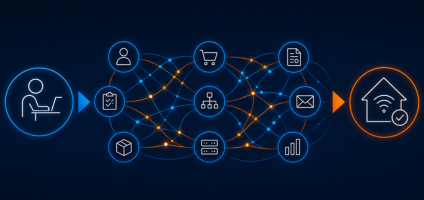
At this stage, AI agents can move from recommending a next step to coordinating tasks across connected operational systems. They use approved interfaces and established workflows to gather context, initiate supported actions, and check results.
Consider a subscriber troubleshooting scenario. An agent could retrieve the service record from the CRM, request device status from a network platform, and use an existing diagnostic workflow. It could then create or update a ticket with the findings and route unresolved issues to the appropriate team.
That example depends on more than the agent’s ability to reason. Customer and device records must match, system interfaces must be available, and the workflow must return a result the agent can interpret.
Capabilities to Build
Expose reusable APIs and workflows through an integration layer maintained separately from the agent. Define the information each interface accepts, the actions it supports, and the results it returns.
Preserve operational context as a task moves between platforms. A customer identifier, service identifier, and device identifier need to remain associated throughout the process so that actions apply to the intended service.
Build result verification into the workflow. An accepted API request may indicate that processing has started; the workflow still needs to confirm whether the intended change completed. Return clear status information and actionable errors when it does not.
Controls and Organizational Changes
Operators need to define which tasks an agent may initiate, which require human review, and how access permissions are enforced by the systems executing the work. These are implementation requirements across the operator’s environment.
For the integration foundation, focus on reliable execution: validate requests, avoid duplicate actions, monitor connection failures, and route exceptions to the responsible team. Where an action cannot be completed, preserve enough context for a person to continue the investigation.
IT, network operations, and customer care should agree on what constitutes a completed task. Assign owners to the interfaces and workflows so that changes in a billing platform or network system do not silently disrupt the process.
Measure: verified task completion, cross-system execution time, failed handoffs, duplicate actions, and exceptions requiring manual resolution.
Next step: extend to another workflow after the first demonstrates reliable execution and measurable operational value. Keep human review where the consequences of a decision warrant it.
How Can an ISP Assess Its AI Readiness?
Choose one workflow and ask:
- Can we reliably connect the relevant customer, service, location, and device records?
- Do we know which source is authoritative and how current the information must be?
- Can an approved workflow complete the task and handle exceptions?
- Can AI produce useful recommendations against documented evaluation criteria?
- Can an agent use established interfaces to complete a cross-system task, verify the result, and hand off exceptions?
Record evidence for each answer. Use the first unmet prerequisite to choose the next investment.
For a multi-system action, reliable integration and workflow execution usually need attention before agent autonomy. A narrow, read-only assistant may be useful earlier when its information and access are sufficiently controlled.
How Intelegrate Supports the AI-ready ISP
ETI’s role in this maturity model centers on interoperability: connecting the systems, data, and workflows that broadband operations depend on.
Intelegrate can support that foundation by enabling data exchange and workflows across existing operational platforms. APIs and adapters help make system capabilities available through reusable interfaces, allowing providers to modernize incrementally as their operational needs evolve.
Keeping integration separate from an individual AI agent also makes those connections useful beyond a single AI project. The same underlying interface or workflow can support business applications, rules-based automation, and AI-assisted processes.
Providers still need to select and evaluate AI tools, define their operating policies, and establish appropriate oversight. Intelegrate’s contribution is the integration foundation that helps those tools interact with broadband systems and workflows.
Start with one operational bottleneck. Contact ETI to help connect the systems and workflows it depends on—and help establish a practical foundation for AI.
Frequently asked questions
What makes an ISP AI-ready?
An ISP is AI-ready for a particular use case when relevant systems can provide reliable data and support the workflows that use case requires. Clear ownership, appropriate permissions, and measurable results help the provider put that capability into practice.
Does an ISP need to replace legacy OSS/BSS systems before using AI?
Not necessarily. APIs, adapters, and an integration layer can make existing systems accessible incrementally. Feasibility depends on available interfaces, data quality, supportability, and security requirements.
What is the difference between automated workflows and agentic AI?
Automated workflows follow predefined rules and execution paths. Agentic AI can select tools and steps toward an objective within granted permissions. Both require monitoring and exception handling.
Should system integrations be built inside the AI agent?
Keep reusable system integrations in a separate integration layer. Agents can call approved interfaces while connection management, validation, and access enforcement remain independently maintainable.
Should every ISP aim for fully autonomous operations?
Providers should choose the level of autonomy that fits each workflow. Human review may remain the appropriate long-term choice for decisions with significant service, financial, or customer consequences.
© 2026 Enhanced Telecommunications.