The following summary has been condensed for length and readability. To listen to the full discussion, click . This episode is sponsored by and .
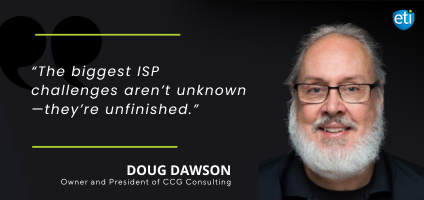
In this episode of The Broadband Bunch, host Jeff Boozer chats with Doug Dawson, President of CCG Consulting and author of Pots and Pans blog, to discuss the reality across the broadband industry: the same operational challenges continue to resurface year after year for ISPs.
Inspired by Dawson’s blog post “ISP New Year’s Resolutions,” the conversation explores why initiatives—like improving data systems, reducing operational costs, and optimizing customer experience—often remain unfinished. Drawing from conversations with dozens of service providers, Dawson highlights the common thread: ISPs know what needs to be done, but constraints around time, cost, and staffing keep those priorities on the back burner.
This episode offers a ground-level look at the operational bottlenecks that prevent broadband providers—especially small and mid-sized ISPs—from reaching their full potential.
The Reality of ISP Operations: Limited Time, Limited Resources
Many ISPs, particularly in rural and mid-tier markets, are heavily focused on network expansion and construction. While growth is essential, it often comes at the expense of internal improvements.
Back-office functions—like data management, reporting, and process optimization—are frequently understaffed or deprioritized. As a result, key initiatives that could improve efficiency and profitability are delayed year after year.
Dawson points out that this is not due to a lack of awareness. Operators are fully aware of their gaps. The challenge lies in execution.
Integrated Records: The Foundation ISPs Struggle to Build
Many ISPs operate with disconnected platforms for billing, network management, customer records, and mapping.
An ideal system would provide a unified view of the customer, including:
However, achieving this level of integration requires significant time, cost, and ongoing maintenance. For smaller operators, the effort to consolidate and maintain accurate data can feel overwhelming.
The result? Data silos persist, limiting visibility and slowing down operations.
Reducing Truck Rolls: A Cost Problem Tied to Visibility
Truck rolls remain one of the most expensive operational challenges for ISPs—especially in rural areas where travel time alone consumes a significant portion of a technician’s day.
Many unnecessary truck rolls occur due to:
-
Lack of remote diagnostics
-
Limited network monitoring capabilities
-
Insufficient staffing for centralized troubleshooting
Without a dedicated NOC (Network Operations Center) or reliable remote tools, providers often default to sending technicians into the field—even for issues that could have been resolved remotely.
Improving data visibility and diagnostics is key to reducing these costs, but again, it requires investment in systems and processes that many ISPs struggle to prioritize.
The Profitability Blind Spot: Why Financial Data Isn’t Enough
While accounting systems track revenue and expenses, they often fail to provide actionable insights. Operators may know their costs, but not:
-
Which expenses are controllable
-
Where inefficiencies exist
-
How vendor relationships impact margins
Dawson notes that some ISPs continue paying for outdated services, maintenance agreements, or vendor contracts simply because they haven’t revisited them in years.
This lack of financial clarity can quietly erode profitability over time.
Rising Benefits Costs: A Growing Pressure Point
Employee benefits—particularly healthcare and retirement contributions—are becoming one of the fastest-growing expenses for ISPs.
For many smaller providers, benefits are part of an unspoken agreement with employees: competitive compensation may be limited, but strong benefits make up the difference.
However, rising costs are forcing difficult decisions. Cutting benefits risks employee dissatisfaction and turnover—especially in rural markets where skilled labor is already hard to find.
This creates a long-term challenge with no easy solution, putting additional pressure on already tight margins.
The Sales Gap: Why ISPs Miss Business Opportunities
Many ISPs excel at engineering and network operations—but struggle with sales, particularly when it comes to business customers.
Selling to businesses requires a different approach:
-
Understanding customer needs
-
Communicating value beyond price
-
Maintaining ongoing relationships
Dawson emphasizes that sales is not a one-time event—it’s a continuous process. Without dedicated sales expertise, many ISPs fail to capture available opportunities in their own markets.
This gap limits revenue growth and reduces the return on infrastructure investments.
Inventory Management: The Problem Everyone Avoids
Inventory is another universal challenge—and one that often gets ignored.
Many ISPs lack accurate records of:
Cleaning up inventory requires time, coordination, and detailed accounting work. As a result, it’s frequently postponed or handled superficially.
While it may seem like a minor issue, poor inventory management can impact financial reporting, tax compliance, and operational efficiency.
Why These Problems Persist Across the Industry
Despite the wide range of challenges discussed, Dawson makes one point clear: there is no single “most important” issue.
Every ISP has its own version of this list.
What matters most is identifying the problem that consistently rises to the top—and taking action on it. Operators already know where their gaps are. The real challenge is prioritizing and executing improvements in a resource-constrained environment.
Key Takeaways for ISPs Looking to Improve Operations
This episode highlights several important lessons for broadband providers:
-
Data integration is foundational to improving efficiency and visibility
-
Operational costs like truck rolls can be reduced with better tools and processes
-
Profitability requires deeper insight than standard accounting reports provide
-
Employee costs will continue to rise, requiring strategic planning
-
Sales capabilities are essential for capturing business market opportunities
-
Inventory and internal processes matter, even if they’re easy to ignore
Ultimately, progress doesn’t require solving everything at once. It starts with addressing the most pressing issue—and building momentum from there.
Final Thoughts: From Awareness to Action
Doug Dawson’s insights offer a realistic view of the challenges facing today’s ISPs. These are not new problems—but they are becoming more urgent as competition increases and margins tighten.
The path forward is not about perfection. It’s about prioritization, consistency, and taking incremental steps toward better operations.
For ISPs willing to confront these long-standing issues, the opportunity is clear: improved efficiency, stronger profitability, and a more resilient business.
People Also Ask
What are the biggest challenges facing ISPs today?
The biggest challenges facing ISPs include managing operational costs, integrating data across systems, reducing truck rolls, understanding true profitability, and dealing with rising employee benefit costs. Many ISPs also struggle with sales to business customers and maintaining accurate inventory records.
Why do ISPs struggle with data integration?
ISPs often use multiple disconnected systems for billing, network management, and customer data. Integrating these systems requires significant time, cost, and ongoing maintenance, which can be difficult for smaller providers with limited resources.
How can ISPs reduce truck rolls?
ISPs can reduce truck rolls by improving remote diagnostics, investing in network monitoring tools, and implementing centralized troubleshooting processes such as a NOC (Network Operations Center). Better data visibility helps resolve issues without sending technicians into the field.
Why don’t ISPs raise their prices more often?
Many ISPs are hesitant to raise prices due to fear of customer churn, especially in small or rural communities. However, consistent and well-communicated rate increases are often accepted by customers and can help maintain profitability.
What impacts ISP profitability the most?
Key factors impacting ISP profitability include unmanaged vendor costs, inefficient operations, rising employee benefits, and lack of visibility into financial data. Many ISPs also miss revenue opportunities due to limited sales capabilities.
FAQ
What is an ISP (Internet Service Provider)?
An ISP is a company that provides internet access to residential and business customers. ISPs manage network infrastructure, customer service, billing systems, and service delivery.
What are integrated records in telecom?
Integrated records refer to a unified system that combines customer data, network infrastructure, billing information, and service history into a single view. This helps ISPs improve efficiency, troubleshooting, and customer experience.
Why are truck rolls expensive for ISPs?
Truck rolls are costly because they involve technician labor, travel time, fuel, and operational overhead. In rural areas, long travel distances make truck rolls even more expensive, especially when visits could have been avoided with remote diagnostics.
How do ISPs improve operational efficiency?
ISPs can improve efficiency by integrating systems, automating workflows, reducing manual processes, improving data accuracy, and investing in tools that provide real-time network visibility.
Why is inventory management important for ISPs?
Inventory management ensures that ISPs have accurate records of equipment, reduces unnecessary costs, and supports better financial reporting. Poor inventory tracking can lead to wasted resources and accounting issues.
What is a NOC in telecom?
A NOC (Network Operations Center) is a centralized team or system that monitors network performance, detects issues, and resolves problems—often remotely—before they impact customers.
© 2026 Enhanced Telecommunications.