

The Short Answer: Telecom service assurance is how operators monitor, manage, and maintain service quality across their networks in real time. It gives your team end-to-end visibility into network performance and ties that performance directly to subscriber experience, so you can catch and resolve issues before customers notice them.
For telecom and broadband providers, the bar is constantly being raised. Subscribers don’t just compare you to other telecom operators, they compare their experience to every digital service they use. When streaming apps, cloud platforms, and mobile networks all deliver consistently, a slow connection or unexplained outage from their broadband provider stands out fast.
Service assurance gives operators the tools to stay ahead of those expectations and keep customers happy. It moves your team from reacting to complaints to proactively managing the health of every service across every layer of your network.
What is Telecom Service Assurance?
The Definition
Telecom service assurance is the practice of monitoring, managing, and optimizing service quality across a communication service provider’s network. It covers everything from detecting faults and tracking performance metrics to correlating network events with their impact on the subscriber experience.
It’s broader than basic network monitoring. Where monitoring tells you when a device is down or a link is saturated, service assurance connects that information to what the customer is actually experiencing. A spike in packet loss on one segment of your network might not matter if it’s not carrying active subscriber traffic. Service assurance helps your team focus on the issues that actually affect service delivery.
What It Covers
A service assurance platform typically spans several areas:
- Performance management — tracking network and service metrics across devices, links, and service paths in real time
- Fault detection and correlation — identifying network issues and mapping them to affected services and subscribers
- Anomaly detection — flagging unusual patterns in network traffic or device behavior before they escalate
- Service quality tracking — measuring the actual experience subscribers receive, not just whether the network is “up”
- Customer experience correlation — tying network events to subscriber impact so your team can prioritize based on who’s affected
For telecom operators managing hybrid networks across fiber, copper, coax, and wireless, service assurance brings all of that into a single operational view.
Why Service Assurance Matters Now
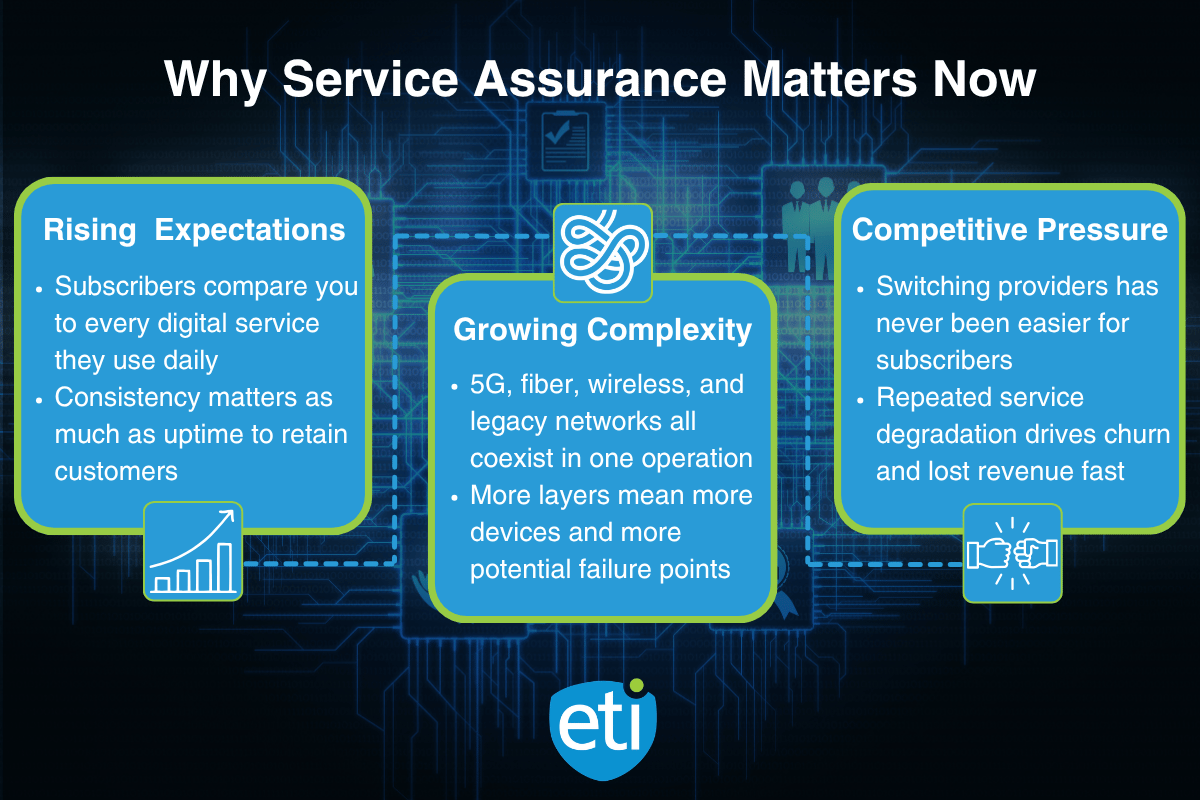
Rising Subscriber Expectations
Subscribers don’t evaluate their broadband experience in a vacuum. They measure it against every other digital service they interact with daily. When video calls connect instantly, apps load without lag, and streaming services buffer-free, a slow DNS resolution or a choppy VoIP call from their service provider feels like a failure.
Customer satisfaction in telecom is increasingly tied to consistency. It’s not just about uptime. It’s about delivering the same quality of experience every time a subscriber connects.
Growing Network Complexity
The networks that telecommunication providers manage today look nothing like they did a decade ago. 5G networks, fiber-to-the-home, fixed wireless, cloud services, and legacy copper all coexist in the same operation. Each layer adds new data, new devices, and new potential failure points.
For operators running hybrid networks, a single customer’s service path might cross multiple technologies between the headend and the home. Without service assurance providing end-to-end visibility across each of those layers, pinpointing where a problem originated gets exponentially harder as the network grows, leading to higher costs and longer downtimes.
Competitive Pressure
In the telecommunications industry, switching providers has never been easier. When service degradation happens repeatedly or takes too long to resolve, enterprise customers and residential subscribers alike start looking at alternatives.
Service assurance gives operators a competitive advantage by reducing the issues customers see and shortening resolution times for the ones they do. Lower churn, fewer escalations, and a reputation for reliability build better relationships and help you consistently retain your customers.
How Service Assurance Improves Performance and Customer Experience
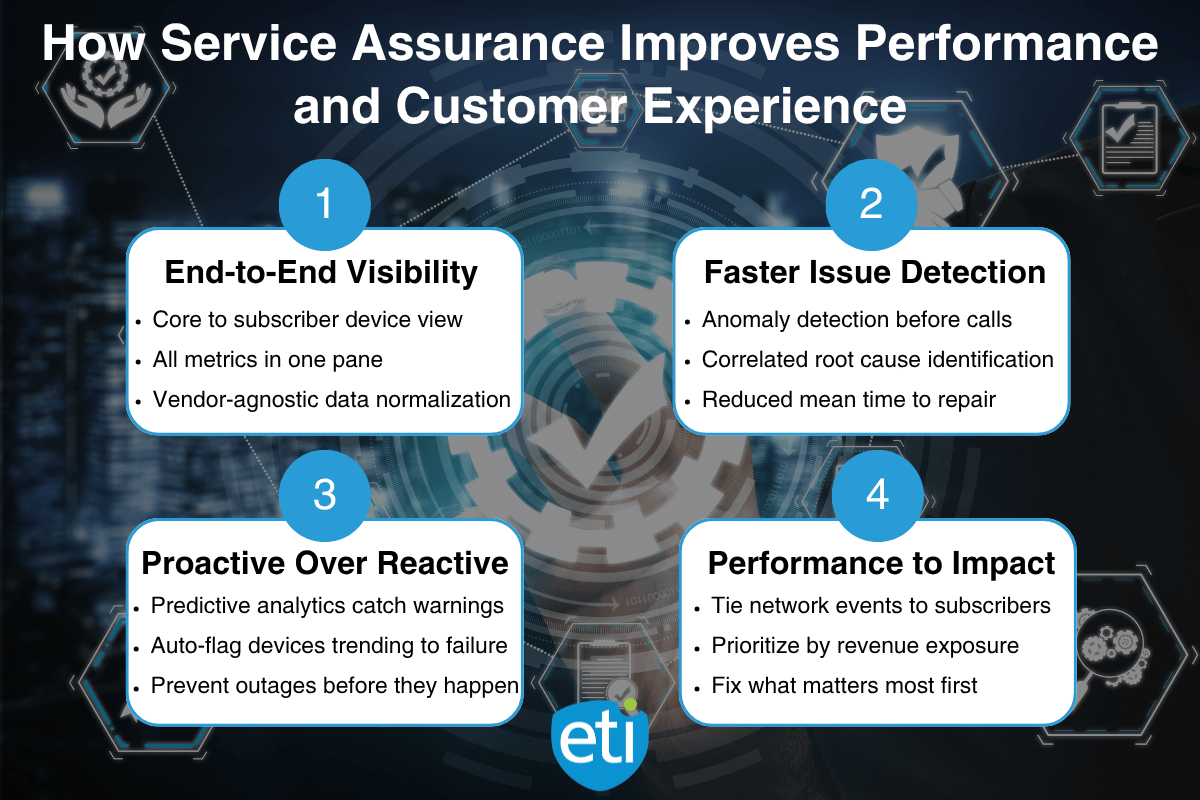
End-to-End Visibility
Service assurance starts with seeing everything. Your team needs a real-time view of network performance across every layer, from core infrastructure to the last mile to the device in the subscriber’s home.
That means pulling telemetry, fault data, and performance metrics from across your operation into a single view. Intelegrate Observe does this by normalizing device telemetry across vendors so your NOC team isn’t bouncing between dashboards to understand what’s happening on the network.
Faster Issue Detection and Resolution
When a service issue occurs, the clock starts. The longer it takes to detect, diagnose, and resolve the problem, the more subscribers it affects and the more calls your customer service team handles.
Service assurance platforms use anomaly detection and automation to shrink that timeline. Instead of waiting for a subscriber to call in, the system flags the issue in real time based on performance thresholds or traffic pattern changes. Correlated data across devices helps your team identify the root cause faster, reducing mean time to repair.
Proactive Over Reactive
The real value of service assurance is catching potential issues before they cause service degradation. Predictive analytics and machine learning models trained on historical network data can identify early warning patterns: a device trending toward failure, a link approaching capacity, or a service path showing intermittent errors.
AI-powered analytics turn your operation from one that reacts to outages into one that prevents them. Intelegrate Connect supports this by keeping your telemetry, OSS, and BSS systems integrated so the data feeding those models is current and consistent.
Connecting Network Performance to Customer Impact
Not every network issue affects subscribers equally. A failing port on an underutilized switch is a different priority than one serving a dense residential area or a major enterprise customer.
Service assurance ties network events to subscriber impact. Your team can prioritize based on how many customers are affected, which service tiers are involved, and what the revenue exposure looks like. That shift from “fix what’s broken” to “fix what matters most” is where service assurance drives the biggest improvement in both operational efficiency and subscriber experience.
What to Look for in a Service Assurance Platform
Not all service assurance solutions are built for the same environment. Here’s what matters most for telecom and broadband operators.
Real-Time Monitoring Across Hybrid Networks
Your platform needs to be able to handle every technology in your network, whether that’s fiber, copper, coax, fixed wireless, or a mix of all four. If your service assurance tool only covers part of your infrastructure, you’re left with blind spots that subscribers will find before your team does.
AI and Machine Learning
Anomaly detection, predictive maintenance, and predictive analytics all depend on AI-powered analytics that learn from your network’s behavior over time. Look for a platform that doesn’t just alert on static thresholds but adapts to patterns in your specific environment.
Open APIs and Integration
Service assurance data is most valuable when it connects to the systems your team already uses. A platform with open APIs that integrates with your existing OSS/BSS, ticketing, and network management tools keeps actionable insights flowing into existing workflows instead of creating another silo.
Actionable Insights Over Dashboards
Dashboards are useful, but they’re not a solution on their own. Your platform should turn collected data into prioritized alerts, automated responses, and clear next steps your team can act on without digging through charts first.
ETI’s Intelegrate platform brings these capabilities together for telecom and broadband providers. Intelegrate Observe delivers real-time, vendor-agnostic telemetry and monitoring, Intelegrate Connect integrates that data with your OSS, BSS, and operational systems, and Intelegrate Automate closes the loop with automated workflows that act on what the data surfaces. See how it fits your network.
Building a Service Assurance Strategy That Scales
The telecommunications industry is only getting more complex. More technologies, more traffic, more customer expectations. Operators who invest in service assurance now build the foundation for operational excellence as their networks grow, whether that means expanding fiber footprints, integrating 5G networks, or onboarding enterprise customers with higher service level requirements.
Service assurance is how telecom operators close the gap between network performance and customer experience. It gives your team the visibility to catch issues early, the data to prioritize what matters most, and the automation to resolve problems before subscribers pick up the phone.
Start by identifying where your biggest visibility gaps are today and where service degradation is costing you the most in churn, truck rolls, or resolution time, and build from there.
Want to see how we fit your environment? Contact ETI to walk through your service assurance and network monitoring needs.