The following summary has been condensed for length and readability. To listen to the full discussion, click . This episode is sponsored by and .
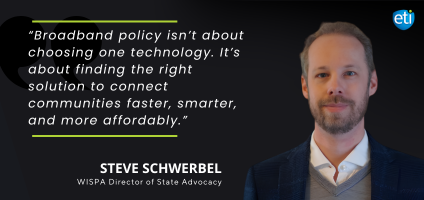
Broadband policy decisions are increasingly being made at the state level, and few people have a better view of that landscape than Steve Schwerbel, Director of State Advocacy at WISPA. In this episode of The Broadband Bunch, recorded live at the WISPAmerica 2025 in Oklahoma City, host Brad Hine sits down with Schwerbel to discuss BEAD funding, fixed wireless broadband, state legislation, and the future of broadband deployment in rural America.
The conversation highlights how broadband policy has evolved from a primarily federal discussion into a fast-moving state-by-state effort involving governors, legislatures, broadband offices, and local providers. Schwerbel explains how WISPA works directly with policymakers across all 50 states to advocate for practical, technology-neutral broadband solutions that can quickly connect underserved communities.
Why State Broadband Policy Matters More Than Ever
As BEAD funding continues to move through the approval and implementation process, states now have significant authority over how broadband expansion projects are prioritized and funded. Schwerbel explains that this shift has dramatically increased the importance of state advocacy and local engagement.
His role involves working with:
- State broadband offices
- Governors and their policy teams
- State legislatures
- Community broadband advocates
- Fixed wireless internet service providers
The goal is to help policymakers understand that broadband deployment is not a one-size-fits-all challenge.
Rather than pushing a single technology approach, WISPA promotes tech-neutral broadband policy. Schwerbel argues that fiber, fixed wireless, and satellite solutions all have a role depending on geography, cost, speed of deployment, and local infrastructure conditions.
Fixed Wireless Broadband Is Filling Critical Gaps
One of the strongest themes throughout the episode is the growing role of fixed wireless broadband in solving connectivity challenges.
Schwerbel explains that many states simply do not have enough funding to build fiber to every location that remains unserved. In remote, mountainous, agricultural, or heavily forested areas, fiber deployment can take years and cost dramatically more than alternative technologies.
Fixed wireless offers several advantages:
- Faster deployment timelines
- Lower infrastructure costs
- Greater flexibility in difficult terrain
- Faster disaster recovery capabilities
- Reliable broadband access for rural communities
According to Schwerbel, fixed wireless networks can often be deployed in months rather than years. That speed can have a major impact on local economies, education access, healthcare availability, and workforce development.
Real-World Broadband Success Stories
The episode includes several powerful examples of how fixed wireless providers are solving real-world connectivity problems.
California Agricultural Connectivity
In rural California farming communities, fixed wireless broadband is enabling smart agriculture technologies that improve water monitoring, livestock management, and environmental efficiency. Farmers can now use connected sensors and real-time data systems that previously would not have been possible in remote areas.
The technology also helps create new technical job opportunities for local workers by introducing network management and digital monitoring skills into agricultural operations.
Hurricane Helene Disaster Recovery
Schwerbel also shares stories from providers impacted by Hurricane Helene in North Carolina. While flooding and landslides damaged portions of fiber infrastructure, fixed wireless providers quickly restored service using flexible wireless deployments and temporary middle-mile solutions.
In some areas, fixed wireless operators partnered with Starlink to bridge damaged network segments and reconnect communities much faster than traditional rebuild timelines would allow.
Tribal Broadband Deployment in New Mexico
Another example highlights tribal broadband providers in rural New Mexico that launched fixed wireless networks during the pandemic to connect underserved tribal communities. These deployments provided internet access for education, healthcare, remote work, and communication during a critical period when connectivity became essential for daily life.
Broadband Policy Challenges States Are Facing
The discussion also explores several major legislative and regulatory topics currently being debated across the country.
Broadband Equipment Tax Exemptions
Many states are considering legislation that would exempt broadband infrastructure equipment from sales taxes. Supporters argue this would lower deployment costs and allow providers to invest more capital directly into network expansion.
Labor and Certification Requirements
Some states are debating labor certification rules tied to broadband construction projects. Schwerbel notes that smaller broadband providers often rely on local workers and on-the-job training programs, making overly burdensome certification requirements difficult for smaller operators to manage.
Pole Access and Right-of-Way Rules
Access to utility poles and rights-of-way continues to be a major issue for broadband deployment. Providers need affordable and timely access to infrastructure in order to expand service efficiently.
Schwerbel emphasizes that community-based ISPs, fixed wireless operators, co-ops, and fiber providers all need fair access to infrastructure if states want to accelerate broadband expansion.
Broadband Has Become a Bipartisan Priority
One of the most notable points in the conversation is Schwerbel’s observation that broadband remains one of the few truly bipartisan infrastructure issues in the United States.
Lawmakers across the political spectrum recognize that reliable internet access now affects:
- Education
- Economic development
- Healthcare
- Agriculture
- Emergency response
- Remote work opportunities
The pandemic permanently changed how policymakers view broadband connectivity. Images of students sitting in parking lots to access Wi-Fi highlighted the severity of the digital divide and created new urgency around broadband deployment.
Schwerbel explains that state legislators regularly hear from constituents who still lack reliable internet access, making broadband an issue that cuts across both urban and rural communities.
The DIY Spirit Behind the WISP Industry
Another major takeaway from the episode is the culture of innovation inside the wireless ISP industry.
Many WISP operators built their businesses from the ground up by climbing towers, installing antennas, and solving connectivity problems directly within their communities. Schwerbel notes that many company leaders in the industry still maintain that hands-on mentality today.
That entrepreneurial culture has helped fixed wireless providers adapt quickly during disasters, reach hard-to-serve locations, and continue innovating in areas where traditional deployment models struggle.
Why Tech-Neutral Broadband Policy Matters
Schwerbel repeatedly returns to the idea that broadband deployment should focus on outcomes rather than forcing a single technology model.
Communities need:
- Reliable connectivity
- Affordable service
- Faster deployment timelines
- Resilient infrastructure
- Practical long-term solutions
In some areas, fiber may be the best option. In others, fixed wireless or hybrid solutions may provide faster and more cost-effective access. WISPA’s position is that policymakers should evaluate all available technologies instead of limiting funding or planning to one deployment method.
That flexibility is becoming increasingly important as states work to close remaining broadband coverage gaps.
Final Thoughts
This episode of The Broadband Bunch gives a look at the policy, technology, and advocacy work shaping broadband expansion across the country. Steve Schwerbel provides valuable insight into how states are navigating BEAD funding, infrastructure challenges, and evolving deployment strategies while balancing cost, speed, and connectivity goals.
The conversation also reinforces the importance of fixed wireless broadband as part of a broader technology-neutral strategy for closing the digital divide and improving connectivity for underserved communities.
For broadband providers, policymakers, and industry leaders, the episode provides a timely snapshot of the challenges and opportunities currently shaping the future of broadband infrastructure in the United States.
People Frequently Ask
What is WISPA?
WISPA is a national trade association that represents wireless internet service providers and advocates for technology-neutral broadband policy across the United States. The organization works with policymakers, broadband offices, and providers to help expand internet access in underserved communities.
What is fixed wireless broadband?
Fixed wireless broadband delivers internet service using radio signals transmitted between towers and customer equipment rather than relying entirely on buried fiber or cable infrastructure. It is often used in rural or difficult-to-reach areas where traditional wired deployment may be too expensive or time-consuming.
Why is fixed wireless important for rural broadband?
Fixed wireless allows providers to deploy broadband networks faster and at a lower cost in rural areas. It can reach farms, mountainous regions, tribal lands, and remote communities where fiber deployment may take years or require significantly more funding.
What is BEAD funding?
The Broadband Equity, Access, and Deployment (BEAD) Program is a federal initiative designed to expand high-speed internet access across the United States. States receive funding to support broadband infrastructure projects aimed at closing the digital divide.
Why are states playing a bigger role in broadband policy?
States now have more authority over broadband deployment decisions because of programs like BEAD. State broadband offices help determine project priorities, funding eligibility, technology considerations, and infrastructure planning.
How does WISPA approach broadband technology?
WISPA supports a tech-neutral approach, meaning the organization believes fiber, fixed wireless, satellite, and hybrid solutions all have a role depending on the needs of each community.
Can fixed wireless support disaster recovery?
Yes. Fixed wireless networks are often faster to restore after storms or natural disasters because they can be deployed rapidly and adapted to damaged infrastructure conditions.
Q&A
Q: What does Steve Schwerbel do at WISPA?
Steve Schwerbel serves as Director of State Advocacy for WISPA. His role involves working with state broadband offices, governors, legislators, and providers across all 50 states to support broadband policy and advocacy efforts.
Why is tech neutrality such a major topic in broadband policy?
Tech neutrality allows communities to choose the broadband solution that best fits their geography, budget, and deployment timeline. Instead of forcing a single technology approach, policymakers can evaluate fiber, fixed wireless, satellite, and hybrid models based on local needs.
How does fixed wireless compare to fiber deployment?
Fiber provides extremely high-capacity connectivity, but deployment can be expensive and time-consuming in remote areas. Fixed wireless can often be deployed much faster and at a lower cost while still delivering reliable broadband service.
What challenges are states facing with broadband expansion?
States are currently balancing several issues, including:
- Broadband infrastructure costs
- Labor and workforce requirements
- Pole and right-of-way access
- Tax policy
- Deployment timelines
- Technology selection for BEAD-funded projects
How did fixed wireless help during Hurricane Helene?
According to Steve Schwerbel, some providers used fixed wireless combined with satellite backhaul solutions to restore connectivity after portions of fiber infrastructure were damaged by flooding and landslides.
Why is broadband considered a bipartisan issue?
Reliable internet access affects education, healthcare, agriculture, economic development, remote work, and emergency response. Lawmakers across the political spectrum recognize broadband as essential infrastructure for modern communities.
What makes the WISP industry unique?
Many wireless internet service providers started as community-driven operations built by entrepreneurs solving local connectivity problems. That hands-on, problem-solving culture continues to define much of the industry today.
Q: How can providers or policymakers connect with WISPA?
A: Providers and policymakers can learn more through WISPA, where they can find advocacy resources, policy updates, and staff contacts.
© 2026 Enhanced Telecommunications.