The following summary has been condensed for length and readability. To listen to the full discussion, click . This episode is sponsored by and .
Hawaii is on track to become the first fully fiber-enabled state in the United States.
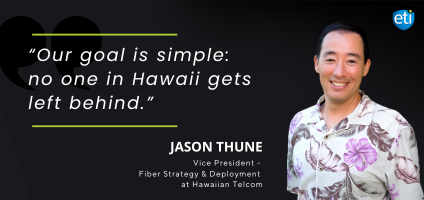
In this episode of The Broadband Bunch, host Brad Hine speaks with Jason Thune, Vice President of Fiber Strategy and Deployment at Hawaiian Telcom. Jason leads a $1.7 billion broadband expansion designed to bring high-speed fiber connectivity to every home and business across the Hawaiian Islands by the end of 2026.
Nearly three decades of telecom experience shape Jason’s approach, along with a deep commitment to the communities he serves. His work includes everything from subsea infrastructure to rural deployments funded by more than $68 million in federal grants. The result is not just a network upgrade, but a transformation in how people live, work, and connect.
The Mission to Build a Fully Fiber-Enabled State
Hawaiian Telcom’s goal is to deliver fiber broadband statewide, regardless of geography, density, or cost.
That mission includes:
- A $1.7 billion investment in fiber infrastructure
- Statewide access to multi-gig symmetrical speeds
- Coverage that extends into the most rural and remote areas
Unlike many deployments that prioritize urban centers first, Hawaiian Telcom took a different approach. The company focused on the hardest-to-reach communities early in the process. This strategy helped close the digital divide faster while proving that even the most difficult builds could succeed.
Why Hawaii Presents Unique Broadband Challenges
Fiber deployment is complex in any environment. Hawaii introduces an entirely different level of difficulty.
Extreme Terrain and Environmental Factors
Hawaii’s landscape shifts dramatically within short distances. Engineers must account for:
- Active volcanic zones and lava flows
- Dense rainforests with extreme rainfall
- Elevation changes from sea level to 15,000 feet
Building infrastructure in these conditions requires flexibility in design and constant adaptation in the field.
Logistics and Supply Chain Constraints
Geographic isolation creates major logistical hurdles:
- Materials often take weeks to arrive by ship
- Transporting equipment between islands requires detailed planning
- Limited storage space increases costs and complexity
In some cases, crews, materials, and equipment must align perfectly within narrow time windows. Any delay can disrupt an entire deployment schedule.
Permitting and Coordination
While Hawaii benefits from fewer governing jurisdictions, coordination remains critical. Strong relationships with state and local agencies help streamline approvals and ensure projects move forward efficiently.
The Role of Technology and Partnerships
Fiber remains the gold standard for broadband, but not every location can support it immediately.
Hawaiian Telcom takes a technology-flexible approach by:
- Partnering with wireless and satellite providers
- Supporting 5G and low Earth orbit (LEO) solutions
- Delivering fiber backhaul to enable those networks
This hybrid model ensures connectivity reaches even the most remote communities while maintaining a long-term focus on fiber expansion.
Partnerships also play a key role in operational efficiency. Simplified network components and reduced inventory requirements help manage costs in a high-expense environment like Hawaii.
Delivering Affordable High-Speed Broadband
Hawaiian Telcom offers:
- 500 Mbps symmetrical service for approximately $30 per month
- Multi-gig services available statewide, including 3 Gbps
This pricing model ensures that high-performance broadband is accessible to both urban and rural residents. Equal pricing across locations eliminates disparities that often exist in other regions.
Real-World Impact on Communities
Broadband is not just about speed. It is about access, opportunity, and quality of life.
Expanding Telehealth Access
Remote communities once required costly flights for medical care. Reliable broadband now enables telehealth services, reducing both cost and travel time.
Supporting Education and Schools
High-speed connectivity allows students and educators to fully participate in digital learning environments, regardless of location.
Enabling Local Economies
Entrepreneurs, remote workers, and small businesses benefit from faster upload speeds, improved reliability, and the ability to operate globally from local communities.
Strengthening Community Engagement
Early engagement with residents helped accelerate deployments. In some cases, local communities actively supported construction efforts, reinforcing the shared value of connectivity.
Lessons for Broadband Providers
Hawaiian Telcom’s approach offers key takeaways for ISPs and telecom leaders:
- Start with underserved areas to maximize impact
- Build strong relationships with local stakeholders
- Plan logistics with precision in constrained environments
- Remain flexible with technology when necessary
- Focus on long-term infrastructure while solving immediate access challenges
These principles can apply far beyond Hawaii, especially as providers work to close connectivity gaps nationwide.
The Road to 2026
The finish line is in sight, but the final phase of deployment remains complex. Hawaiian Telcom continues to expand coverage, optimize infrastructure, and ensure long-term scalability.
Success would mark a major milestone—not just for Hawaii, but for the entire broadband industry.
A fully fiber-enabled state demonstrates what is possible when vision, investment, and execution align.
People Also Ask
What does “fully fiber-enabled state” mean?
A fully fiber-enabled state provides fiber broadband access to nearly all homes and businesses, delivering high-speed, low-latency internet across both urban and rural areas.
Why is fiber broadband important?
Fiber offers faster speeds, greater reliability, and higher capacity than traditional technologies like DSL or cable. It supports modern applications such as streaming, telehealth, and cloud services.
What challenges exist in rural broadband deployment?
Common challenges include high costs, difficult terrain, limited infrastructure, and logistical constraints. Hawaii adds complexity due to its island geography and environmental conditions.
How does fiber compare to wireless or satellite internet?
Fiber delivers the highest performance and reliability. Wireless and satellite solutions help extend coverage to areas where fiber is not immediately feasible.
Frequently Asked Questions
How fast is Hawaiian Telcom’s fiber network?
Hawaiian Telcom offers speeds ranging from 500 Mbps symmetrical to multi-gig services, including 3 Gbps.
When will Hawaii be fully fiber-enabled?
The goal is to achieve statewide fiber coverage by the end of 2026.
How is broadband improving life in Hawaii?
Broadband enhances access to healthcare, education, remote work, and economic opportunities across the islands.
Conclusion
Hawaii’s path to becoming the first fully fiber-enabled state is more than a technical achievement. It represents a shift in how broadband is delivered, prioritized, and experienced.
Jason Thune and his team are proving that even the most challenging environments can support world-class connectivity. Their work sets a new benchmark for the industry—and a clear example of what broadband can accomplish when it is done right.
© 2026 Enhanced Telecommunications.