

The Short Answer: A data silo is a collection of data held by one department or system that isn’t accessible to the rest of the organization. For telecom and broadband operators, data silos form when billing, provisioning, field service, network management, and CRM all store information independently without sharing it across the operation.
Most operators don’t build data silos on purpose. They form naturally. One department picks a tool that fits its needs. Another inherits a legacy system that’s too embedded to replace. Over time, the organization ends up with separate systems holding different versions of the same customer, device, and network data.
The cost isn’t always obvious at first, but it compounds quickly. Inconsistent data slows down decision-making. Duplicate records waste time and resources. Teams work from incomplete information because the data they need lives in a system they can’t access. For operators trying to deliver a fast, reliable subscriber experience, that fragmentation is a problem that touches every part of the business.
What is a Data Silo?
A data silo is a collection of information that’s isolated within one department, system, or tool and isn’t easily accessible to the rest of the organization.
How Data Silos Form
Data silos rarely start as a deliberate choice. They build up over time as different departments solve their own problems independently.
The billing team implements a system that handles invoicing and payment processing. Field service adopts a dispatching tool that tracks work orders and technician schedules. The NOC uses a separate monitoring platform. CRM holds customer records that may or may not match what billing or provisioning has on file.
Each system makes sense on its own. The problem is that none of them were designed to share data with each other. As the organization grows, adds new services, or acquires new infrastructure, more separate systems enter the stack. Each one becomes another silo.
What They Look Like in Practice
In a telecom operation, data silos show up as conflicting information across systems. Billing says a customer has one tier of service. Provisioning shows a different configuration. The CRM has an outdated address. Field service has notes from the last truck roll that never made it back to any other system.
No single team has the full picture. Everyone is working from their slice of the company’s data, and none of those slices match completely. The further apart those records drift, the harder it gets to make confident business decisions or deliver consistent customer service.
The Real Cost of Data Silos
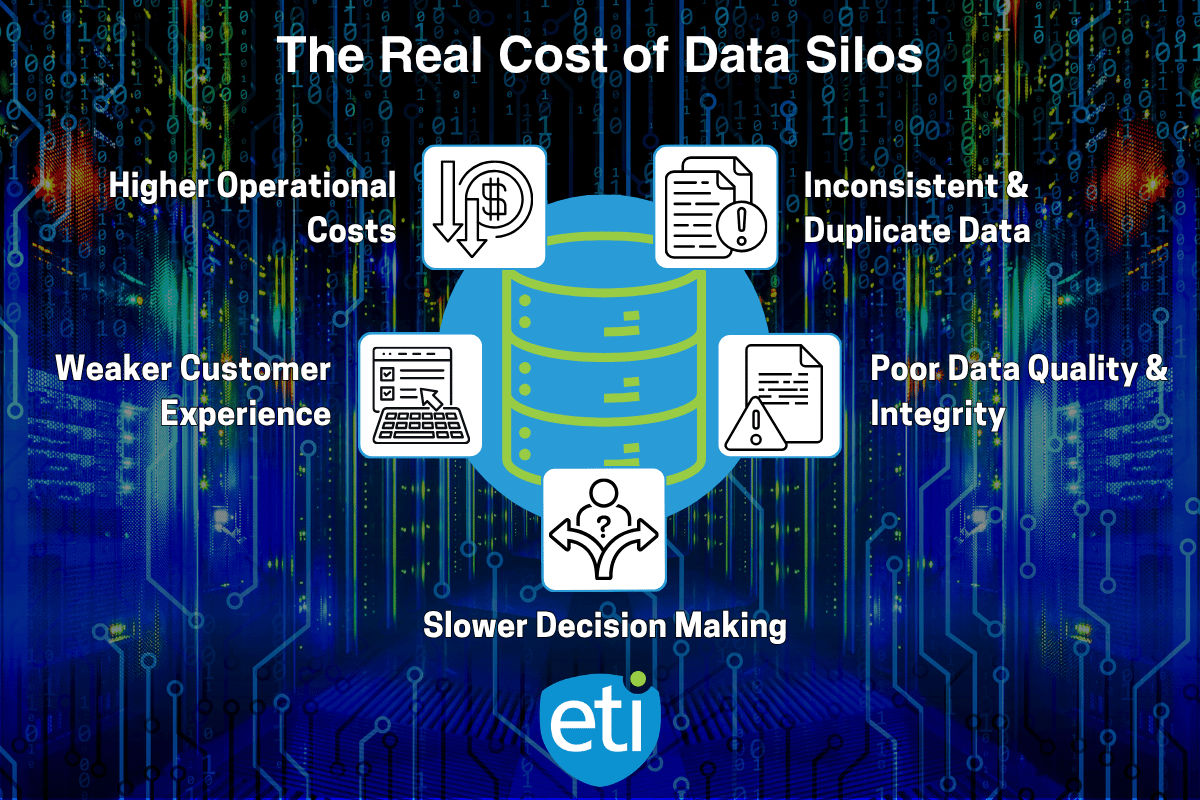
Data silos have a measurable impact on how your operation runs, what it costs, and how subscribers experience your service.
Inconsistent and Duplicate Data
When different systems store the same information independently, records drift apart. A customer’s account looks different in billing than it does in CRM. A device shows as active in provisioning but decommissioned in inventory. Duplicate data builds up across systems, wasting storage space and creating confusion about which record is correct.
For telecom operators, inconsistent data means technicians show up to a job with the wrong information, service activations fail because provisioning and billing don’t agree, and reporting pulls from different sources produce different numbers.
Poor Data Quality and Integrity
Without a shared source of truth, data integrity degrades gradually. Fields get updated in one system but not another. Naming conventions vary across different departments. Over time, the organization’s data becomes less and less reliable, and every team that depends on it makes decisions based on an incomplete picture.
This can become increasingly problematic as AI use increases. The quality of decisions and information generated by AI tools is directly related to the quality of data input to those systems.
Slower Decision-Making
Business leaders need accurate, unified data to make strategic decisions about network investment, service expansion, and staffing. When that data is scattered across separate systems, someone has to pull it together manually before any analysis can happen. That delays decisions and reduces confidence in the numbers behind them.
Higher Operational Costs
Siloed data creates manual work. Teams re-enter data between systems. Staff spend hours reconciling records that should match but don’t. Workarounds become part of the daily routine. Each of those manual steps costs time and increases the chance of errors, driving up operational costs across the entire organization.
Weaker Customer Experience
When a subscriber calls in with an issue, your customer service team needs the full picture: account details, service configuration, device status, and recent interactions. If that information lives in four different systems that don’t talk to each other, the rep is toggling between screens or asking the customer to repeat information they’ve already provided. That slows resolution and frustrates subscribers.
Why Data Silos Are Hard to Fix
Organizational Structure
Data silos often mirror the organizational structure itself. Different departments have their own budgets, priorities, and tools. Each team optimizes for its own workflow, and data sharing across various departments isn’t always a priority when every group is focused on its own deliverables.
Breaking down silos requires buy-in across business units, not just from IT. That’s a coordination challenge as much as a technical one.
Legacy Systems
Many telecom operators still rely on legacy systems that were never built to integrate with modern platforms. These systems hold years of critical data but lack the APIs or data formats needed to share that information with other tools in the stack.
Replacing them is expensive and risky. But leaving them in place without an integration strategy means the silos they create will persist and grow as the rest of the operation modernizes around them.
No Integration Strategy
Without a clear plan for how systems should connect and share data, every new tool added to the operation becomes another potential silo. Teams adopt software that solves an immediate need without considering how it fits into the broader data management picture.
Over time, the result is a patchwork of point-to-point connections, manual exports, and workarounds that nobody fully understands. The longer that goes on, the harder and more expensive it becomes to untangle.
How to Break Down Data Silos
Build a Data Integration Layer
Point-to-point connections between systems don’t scale. Every time you add a new platform, you need a new connection to every system it needs to talk to. That approach breaks down fast.
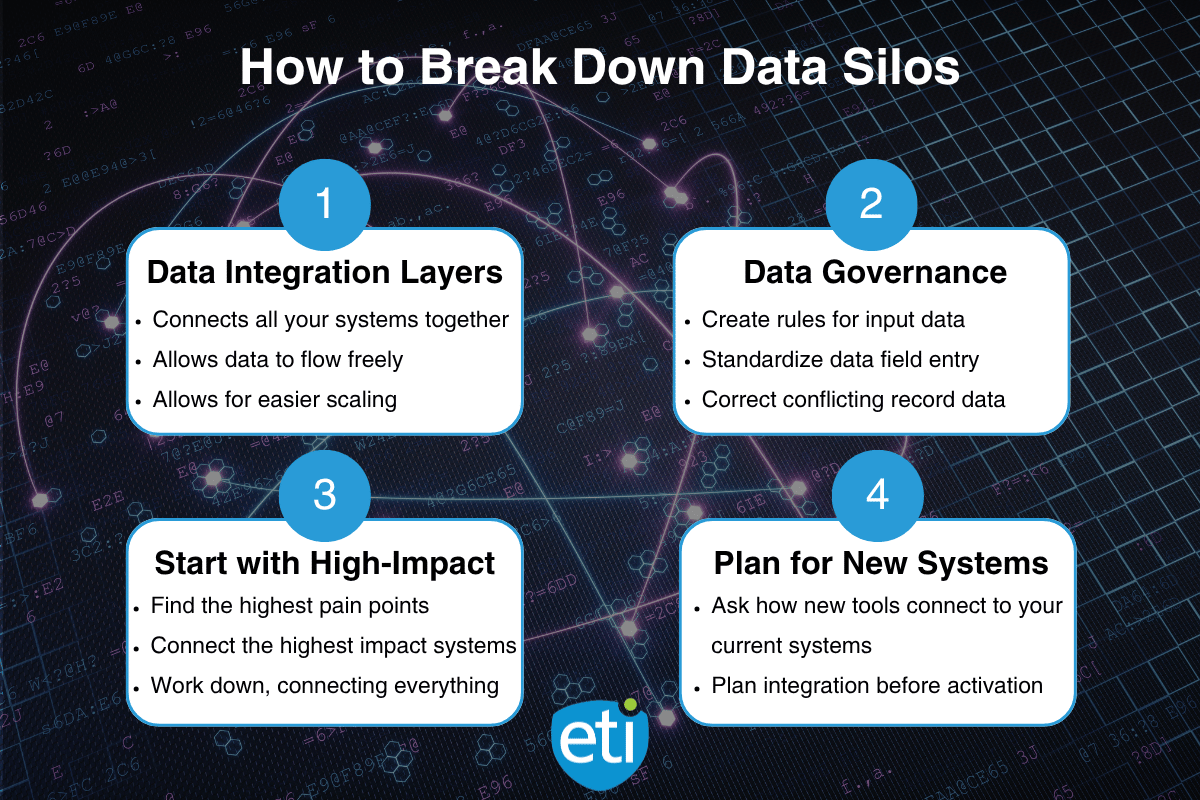
A centralized data integration layer acts as a hub that connects all of your separate systems through a single platform. Data flows between billing, provisioning, field service, CRM, and network management through one integration layer instead of dozens of individual connections. That’s easier to maintain, easier to scale, and far less fragile.
Establish Data Governance
Integration alone won’t fix the problem if the data flowing between systems is still inconsistent. Data governance defines the rules: who owns each data source, how fields are standardized across different departments, how data sharing works, and what happens when records conflict.
Clear governance gives every team confidence that the data they’re pulling from shared systems is accurate and current.
Start with the Highest-Impact Connections
You don’t need to connect everything at once. Identify where siloed data is causing the most pain in your operation and start there.
For most telecom operators, the highest-impact connections are:
- Billing and provisioning, where mismatches cause failed activations and billing errors
- Field service and CRM, where disconnected records mean technicians arrive without full context
- Telemetry and NOC tools, where siloed device data delays issue detection and resolution
Connecting these first delivers measurable results while building the foundation for broader integration.
Plan for Every New System
Make integration a requirement for any new tool added to your stack, not an afterthought. Before adopting a new platform, ask how it connects to your existing systems, what APIs it supports, and whether its data formats align with what the rest of your operation uses.
Every system added without an integration plan is a future silo.
ETI’s Intelegrate platform is built to be that integration layer for telecom and broadband providers. Intelegrate Connect ties your OSS, BSS, and network systems together so data flows where it needs to go without manual workarounds.
The Longer You Wait, the More It Costs
Data silos don’t fix themselves. Left alone, they grow. Every new system, every department workaround, and every manual export adds another layer of fragmentation to your operation.
The cost shows up everywhere: slower service delivery, higher operational costs, frustrated subscribers, and business leaders making decisions from incomplete data. For telecom operators managing increasingly complex networks across more technologies and more subscribers, that fragmentation becomes harder to unwind the longer it persists.
The good news is you don’t have to solve it all at once. Start with the connections that cause the most friction today. Establish clear data governance. Build an integration layer that scales as your operation grows.
ETI’s Intelegrate platform is built to help telecom and broadband operators break down data silos and keep them from coming back. Intelegrate Connect ties your billing, provisioning, field service, CRM, and network systems together through a single integration layer. Intelegrate Observe normalizes device and network telemetry across vendors into one operational view. And Intelegrate Automate ensures that once your systems are connected, workflows run without manual intervention.
Want to see how this fits your operation? Contact ETI to walk through your integration and data management needs.