The following summary has been condensed for length and readability. To listen to the full discussion, click . This episode is sponsored by and .
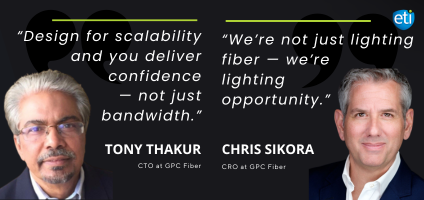
In this episode of The Broadband Bunch, Pete Pizzutillo chats with Chris Sikora, Chief Revenue Officer, and Tony Thakur, Chief Technology Officer at GPC Fiber. Learn how GPC Fiber is executing a 165-mile fiber backbone build across Kentucky, why the region was selected, and how the network is designed to support everything from small businesses to hyperscale demand.
For service providers, infrastructure leaders, and policymakers, the episode shows what it takes to deploy modern fiber networks that balance performance, reliability, scalability, and affordability — while also driving economic development.
Why Kentucky Became a Strategic Growth Market
Market selection is one of the most critical decisions for any network operator. GPC Fiber identified Kentucky as a natural extension of its existing footprint, which spans more than 19,000 route miles across 13 states.
The Louisville–Lexington corridor, with connections north to Cincinnati and Indianapolis, represents a robust economic zone filled with logistics companies, enterprises, hyperscalers, and growing small businesses. By expanding into this region, GPC Fiber could use its existing backbone proximity while addressing clear demand for additional competitive infrastructure.
Beyond simple geographic adjacency, the team emphasized evaluating:
-
Economic growth potential
-
Existing competitive landscape
-
Customer demand across verticals
-
Ability to differentiate with performance and service
This approach ensured the Kentucky build aligned with both technical feasibility and long-term business returns.
From Great Plains Communications to GPC Fiber: A Focused Brand Strategy
What is the reasoning behind launching the GPC Fiber brand for the Kentucky market? While Great Plains Communications carries a strong legacy, leadership recognized that a geographically specific name could create confusion outside its traditional territory.
By introducing GPC Fiber, the company sharpened its messaging around what customers care about most: high-capacity fiber infrastructure and mission-critical connectivity. The rebrand reflects a broader industry trend toward simplifying market positioning as providers expand beyond their historical regions.
Designing a 400G Network Built for the Future
From a technology standpoint, the Kentucky network is engineered as a 400-gigabit backbone, with electronics capable of scaling to 800G and even 1.6 terabits as demand grows. Tony Thakur explains that future-proofing the optical layer is essential, allowing the network to evolve without costly rebuilds.
Key architectural principles include:
-
Ring topology to ensure automatic rerouting during fiber cuts
-
Diverse paths for redundancy and high availability
-
Scalable optical transport supporting massive bandwidth growth
-
Segmented design across backbone, middle mile, and last mile
This layered approach enables GPC Fiber to support a wide range of use cases, from enterprise connectivity and fiber-to-the-tower to hyperscaler transport and advanced cloud applications.
Mission-Critical Connectivity: Aligning Technology With Customer Outcomes
How does GPC Fiber defines mission-critical connectivity. Rather than treating it as a marketing phrase, the company aligns network design directly with customer requirements.
For example:
-
Hospitals may require redundant routes to data centers
-
Enterprises prioritize low latency and application performance
-
Small businesses need reliable, affordable connectivity with minimal complexity
By starting with the customer’s operational needs and mapping network architecture accordingly, GPC ensures its infrastructure delivers measurable business value — not just raw bandwidth.
Vertical Integration as a Competitive Advantage
Unlike providers that rely heavily on third-party contractors, GPC Fiber designs, builds, and supports much of its infrastructure in-house. This vertical integration provides several benefits:
-
Greater control over deployment timelines
-
Faster troubleshooting and repairs
-
Consistent customer experience
-
Higher confidence when committing to performance guarantees
The approach also contributes to strong customer satisfaction and Net Promoter Scores, reinforcing the company’s reputation as a reliable partner.
Supporting Hyperscalers and High-Bandwidth Demand
The conversation highlights GPC Fiber’s experience working with hyperscale customers — organizations that require extremely high-capacity transport and custom builds. Winning this business depends on two primary factors:
-
Geographic expertise to execute complex routes efficiently
-
Operational simplicity, minimizing friction in planning, pricing, and deployment
Because GPC uses similar high-capacity optical technologies as its hyperscale partners, it can collaborate more effectively on design and scaling strategies.
Overcoming Construction Challenges in Kentucky
Deploying fiber in Kentucky presented unique logistical hurdles compared to the flatter Great Plains region. The team encountered:
-
Rocky terrain
-
Hilly landscapes
-
Permitting complexities
By using prior construction experience and adapting engineering approaches, GPC Fiber successfully delivered the network while maintaining performance standards.
Driving Economic Development Through Fiber Infrastructure
Access to high-capacity fiber doesn’t just improve connectivity — it expands opportunity.
Communities gain:
-
Greater provider choice
-
Improved reliability for local businesses
-
Support for remote work and digital services
-
Enhanced attractiveness for new investment
As Chris Sikora notes, the goal isn’t simply to light fiber routes — it’s to “light up opportunity.”
AI, Customer Experience, and Network Evolution
The episode concludes with a discussion on how emerging technologies will shape the next phase of growth. Tony Thakur points to several priorities:
-
Leveraging AI and automation to simplify network operations
-
Enhancing security and managed services
-
Continuing to scale bandwidth as demand accelerates
-
Creating more seamless buying and support experiences
These initiatives reflect an industry shift toward networks that are not only faster, but also smarter and easier for customers to consume.
Key Takeaways for Broadband Leaders
For operators, policymakers, and technology partners, this episode offers several clear insights:
-
Strategic market selection is foundational to successful expansion
-
Future-ready architecture reduces long-term cost and risk
-
Customer-centric design differentiates providers in competitive markets
-
Vertical integration can significantly improve service quality
-
Fiber infrastructure remains a powerful driver of regional economic growth
In Summary
GPC Fiber’s Kentucky expansion demonstrates how thoughtful planning, advanced network design, and strong customer alignment can transform a regional build into a long-term growth platform. As bandwidth demand accelerates and digital infrastructure becomes increasingly critical, projects like this illustrate what it takes to deliver scalable, resilient connectivity that benefits both businesses and communities.
© 2026 Enhanced Telecommunications.