The following summary has been condensed for length and readability. To listen to the full discussion, click . This episode is sponsored by and .
As climate events grow more extreme and frequent, the broadband industry is facing a new kind of challenge: how to keep networks resilient in the face of disaster. In this episode of The Broadband Bunch, host Pete Pizzutillo is joined by Lee Comer, CEO of Go Broadband, and Jeremiah Sloan, Product Marketing Lead at VETRO FiberMap, to explore what true disaster preparedness looks like—and why the time to act is before the storm.
Real-World Experience: From F5 Tornados to Fiber Failures
Lee Comer shares a harrowing story from his time as a lineman with BellSouth during an F5 tornado that devastated Pleasant Grove, Alabama. The scene was chaos: homes destroyed, infrastructure flattened, and all communications down. But amidst the wreckage, Comer saw a fundamental truth—disaster response depends not just on manpower, but on preparation, coordination, and clear leadership.
Jeremiah Sloan echoes the sentiment, drawing on his early career in electric utility GIS mapping after a major ice storm. His takeaway? Chaos compounds when there’s no structured plan in place—and broadband operators can’t afford to be reactive.
The Single Source of Truth: Your Most Valuable Recovery Tool
The absolute necessity of a single source of truth is a recurring theme. Whether it’s through a robust GIS system, network-of-record platform, or standardized field reporting workflows, both guests emphasize the importance of having up-to-date, accessible, and centralized network data.
Without it, companies lose weeks—if not months—trying to rebuild documentation after restoring service. With it, they can coordinate teams, communicate with stakeholders, and make data-driven decisions on the fly.
From Planning to Action: What Broadband Providers Must Do Now
Disaster recovery is about readiness. Lee and Jeremiah walk through best practices for ISPs and fiber operators, including:
-
Conducting field audits and GIS-based network mapping
-
Establishing path diversity and network redundancy
-
Pre-staging materials and identifying critical service locations
-
Assigning severity levels to outages with structured response tiers
-
Aligning engineering, operations, and finance through shared systems
They stress that daily operational readiness—like having the ability to service a single home efficiently—translates directly into disaster resilience when scaled.
Proactive Investment, Not Reactive Expense
So why do some providers still delay these investments? As Lee explains, it often comes down to perception—disaster recovery planning is seen as a cost rather than a strategic advantage. But just like insurance, the value is realized in the moment you need it most.
Jeremiah adds that recovery efforts can even become opportunities to upgrade your network—like increasing fiber capacity while repairing a damaged route. The key is having that forward-thinking mindset and communicating it effectively to boards and investors.
It’s Not If—It’s When
From hurricanes and wildfires to ice storms and tornados, the broadband industry must accept that resiliency is now a competitive differentiator.
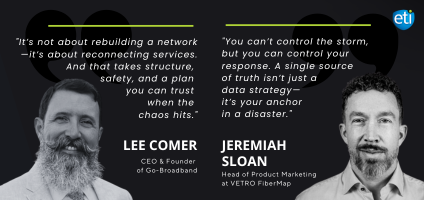
As Lee puts it: “It’s not about rebuilding a network—it’s about reconnecting services.” And as Jeremiah reminds us: “You can’t control the storm, but you can control your response.”
© 2026 Enhanced Telecommunications.