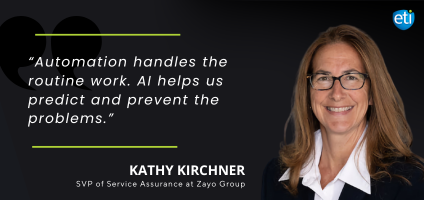
The following summary has been condensed for length and readability. To listen to the full discussion, click . This episode is sponsored by and .
The rapid expansion of fiber infrastructure, AI-driven workloads, and large-scale data centers is transforming how broadband and telecommunications networks operate. In this episode of The Broadband Bunch, host Pete Pizzutillo speaks with Kathy Kirchner, Senior Vice President of Service Assurance at Zayo, about the realities of supporting one of North America’s largest fiber networks—and how AI and automation are reshaping network reliability and customer experience.
From Call Center to Telecom Leadership
Kathy Kirchner’s telecom career began while she was studying telecommunications in college, working evenings in a call center at Sprint. That entry-level role gave her a front-row seat to how networks affect customers directly.
Over the years, she expanded her expertise across multiple operational domains, including:
-
Supply chain and logistics
-
Network operations center (NOC) management
-
Customer support and service delivery
-
Fiber infrastructure design and deployment
-
Technical support for emerging products
Her career included leadership roles across independent telecom companies, cable providers, and 13 years at Comcast, where she helped stand up operational support for Xfinity Mobile. After a brief retirement, she returned to the industry and eventually joined Zayo, where she now oversees service assurance for a network spanning over 133,000 route miles and millions of fiber miles across North America.
Kirchner credits her broad experience across engineering, operations, and customer-facing teams as a key advantage in her current leadership role.
What Service Assurance Means for Modern Fiber Networks
Service assurance is one of the most critical functions in telecom infrastructure. It encompasses everything required to ensure that networks perform reliably and that issues are resolved quickly when they occur.
At Zayo, Kirchner’s organization supports customers across a wide range of connectivity services, including:
Service assurance teams manage both proactive and reactive operations, including monitoring network health, detecting outages, coordinating field technicians, and ensuring service-level agreements (SLAs) are met.
The scale of modern fiber networks creates significant operational complexity. Zayo’s infrastructure supports a wide range of carriers, enterprises, hyperscalers, and technology companies—many of which are now building large AI and cloud computing environments that require massive amounts of bandwidth.
The Real Causes of Fiber Network Outages
One of the biggest operational challenges facing fiber networks is physical damage to infrastructure.
Kirchner explains that fiber cuts remain the leading cause of outages, often resulting from construction activity near shared rights-of-way such as roads, railways, or power infrastructure.
Common causes of fiber outages include:
-
Third-party construction damage
-
Utility work near shared rights-of-way
-
Weather-related events
-
Animal damage to cables
-
Washouts and environmental factors
As fiber deployments scale, these risks increase. Modern long-haul cables often contain hundreds or even thousands of fibers, meaning repairs are significantly more complex and time-consuming than earlier networks built with smaller fiber counts.
To mitigate these risks, operators like Zayo invest in preventative measures such as route patrols, improved locating processes, and stronger coordination with utilities and construction partners.
Why Network Documentation and Data Integrity Matter
One of the biggest operational hurdles in telecom is network documentation accuracy.
Many telecom networks have grown through mergers and acquisitions. Zayo itself has completed numerous acquisitions over the years, which means integrating different technologies, documentation systems, and operational processes.
This can create challenges such as:
-
Incomplete fiber asset records
-
Inconsistent network documentation
-
Multiple alarm and monitoring systems
-
Different equipment platforms across networks
Without clean and accurate data, diagnosing outages and coordinating repairs becomes significantly more difficult.
As Kirchner explains, improving data integrity and documentation consistency is a major focus for network operators who want to improve reliability and reduce operational costs.
Automation vs. AI in Telecom Operations
One interesting discussion in the episode focuses on the distinction between automation and artificial intelligence in telecom networks.
While the terms are often used interchangeably, Kirchner sees them as fundamentally different.
Automation in Telecom Networks
Automation refers to predefined workflows and rules that handle routine operational tasks.
Examples include:
-
Automated dispatching of field technicians
-
Auto-generated trouble tickets from alarms
-
Automated service provisioning via APIs
-
Self-service ordering portals
Automation improves operational efficiency and reduces manual workloads.
AI in Network Operations
AI introduces predictive capabilities that go beyond predefined workflows.
Potential AI applications in telecom operations include:
-
Alarm correlation across complex networks
-
Predictive maintenance to identify equipment failures
-
Network performance forecasting
-
Root cause analysis of outages
In large networks where thousands of alarms may occur during a single outage, AI can drastically reduce the time required to diagnose problems.
A Real Example of AI Improving Operations
Kirchner shares a practical example of AI already deployed within Zayo’s service assurance organization.
When outages occur, customers often request an RFO (Reason for Outage) report. Traditionally, these reports required managers to review large volumes of ticket notes and operational data to determine the root cause and document corrective actions.
The process could take hours.
By implementing an AI solution that reads ticket data and generates structured outage reports automatically, the company reduced that work to approximately 30 minutes of review time instead of hours of manual effort.
This type of targeted AI implementation demonstrates how telecom operators can improve efficiency without completely overhauling their systems.
Preparing for the AI Infrastructure Boom
The rise of artificial intelligence is driving unprecedented demand for network infrastructure.
Large AI training clusters and hyperscale data centers require enormous bandwidth and connectivity between compute clusters, storage systems, and cloud platforms.
Kirchner notes that Zayo is uniquely positioned to support this growth because it is one of the few providers building new long-haul fiber routes at scale.
Industry forecasts suggest that the U.S. may need tens of millions of new fiber miles to support future data center capacity and AI workloads.
This surge in demand is already visible through large connectivity orders from technology companies that require massive fiber capacity between data centers.
Workforce Evolution in the AI Era
Despite concerns that AI may eliminate jobs, Kirchner sees AI as a tool that empowers telecom teams rather than replacing them.
AI allows engineers and operations leaders to spend less time on administrative tasks and more time focusing on:
-
Customer relationships
-
Strategic planning
-
Network improvements
-
Operational leadership
She emphasizes that telecom operations remain a team sport, requiring collaboration across engineering, operations, customer service, and field teams.
Shared accountability and clear performance metrics—such as mean time to repair (MTTR)—are critical to maintaining high service quality.
Advice for Women Entering the Telecom Industry
Kirchner also shares advice for women pursuing leadership roles in technology and telecommunications.
Her key recommendation: stay curious and be willing to take risks.
Many of the most valuable career experiences come from stepping into unfamiliar roles or taking opportunities that may initially seem outside one’s expertise.
By gaining exposure across different functions—from operations and engineering to sales and customer experience—leaders develop a broader understanding of how telecom organizations operate.
The Future of AI in Broadband and Telecom
Looking ahead, Kirchner believes AI will fundamentally change how telecom networks are managed.
Future networks may feature capabilities such as:
-
Predictive outage detection
-
Self-healing network functions
-
Faster incident resolution
-
More proactive customer communication
However, these advancements require strong foundations.
AI systems are only as effective as the quality of the underlying data, meaning telecom operators must prioritize clean documentation, integrated platforms, and consistent operational processes.
Organizations that invest in these foundational improvements today will be best positioned to leverage AI successfully.
Final Thoughts
As broadband infrastructure continues to expand and AI workloads reshape the technology landscape, telecom operators face growing operational complexity.
Leaders like Kathy Kirchner are helping redefine how service assurance works at scale—combining automation, artificial intelligence, and operational discipline to deliver reliable connectivity.
For service providers, infrastructure companies, and technology leaders alike, the message is clear: the future of telecom networks will depend not only on fiber capacity, but also on intelligent operations built on clean data and modern platforms.
People Also Ask: AI, Automation, and Service Assurance in Fiber Networks
How does AI improve fiber network reliability?
AI improves fiber network reliability by analyzing large volumes of network data to identify patterns that signal potential issues before they become outages. Telecom operators use AI to correlate alarms, detect anomalies in network performance, and predict equipment failures. By identifying problems earlier, operators can perform preventative maintenance and reduce downtime, improving overall network stability and customer experience.
What is service assurance in broadband networks?
Service assurance is the process telecom providers use to ensure network services perform reliably and meet service-level agreements (SLAs). It includes monitoring network health, diagnosing outages, dispatching field technicians, and resolving service issues quickly. Service assurance teams typically operate within network operations centers (NOCs) and coordinate across engineering, operations, and customer support groups.
Why are fiber network outages so common?
Most fiber network outages are caused by third-party construction damage. Fiber cables are often installed along roads, railways, and utility corridors, which makes them vulnerable to excavation and infrastructure work. Other causes include severe weather, equipment failures, environmental factors, and accidental damage from animals. Because modern fiber cables contain hundreds or thousands of fibers, repairing outages can be complex and time-consuming.
What role does automation play in telecom operations?
Automation helps telecom providers streamline repetitive operational tasks such as service provisioning, alarm-triggered ticket creation, and technician dispatching. By reducing manual processes, automation allows network operations teams to respond faster to issues and manage larger networks more efficiently. Automation also provides the foundation for more advanced AI-driven network management.
How are telecom companies using AI for network management?
Telecommunications companies are increasingly using AI to improve network monitoring, outage diagnosis, and predictive maintenance. AI systems can analyze network alarms, correlate events across multiple systems, and identify the root cause of problems faster than manual processes. AI is also used to generate incident reports, forecast network capacity needs, and help operators optimize performance across large-scale fiber infrastructure.
How is the growth of AI data centers impacting fiber networks?
AI data centers require massive amounts of bandwidth to connect high-performance computing clusters and cloud platforms. This demand is driving significant expansion of long-haul fiber routes and high-capacity network infrastructure. Telecom providers are building new fiber routes and increasing network capacity to support the connectivity requirements of AI training systems and large-scale data processing environments.
Why is clean network data important for AI in telecom?
AI systems rely on accurate and structured data to generate useful insights. If network documentation, alarm data, or operational records are inconsistent or incomplete, AI tools cannot analyze network conditions effectively. Telecom providers must first consolidate and clean their data sources before AI can deliver meaningful improvements in network operations and reliability.
Frequently Asked Questions About AI, Automation, and Service Assurance in Fiber Networks
What is service assurance in telecom networks?
Service assurance refers to the systems, processes, and teams responsible for ensuring that telecommunications services perform reliably. It includes monitoring network health, detecting outages, coordinating repairs, managing service-level agreements (SLAs), and ensuring customers receive the quality of service they expect. Service assurance teams work across network operations centers (NOCs), field technicians, and customer support teams to diagnose and resolve issues quickly.
How is AI being used in telecom network operations?
Artificial intelligence is increasingly used to improve telecom network operations through predictive analytics and automation. AI can analyze large volumes of network alarms, identify patterns that indicate potential failures, and help operators diagnose outages faster. Common use cases include alarm correlation, predictive maintenance, automated incident analysis, and generating outage reports. These capabilities allow operators to reduce downtime and improve network reliability.
What is the difference between automation and AI in telecom?
Automation uses predefined rules or workflows to complete tasks automatically, such as creating trouble tickets from alarms or dispatching technicians. AI, on the other hand, analyzes data and learns patterns to make predictions or recommendations. For example, automation might trigger a ticket when a device fails, while AI could identify the root cause of the failure or predict the outage before it occurs.
What are the most common causes of fiber network outages?
The most common cause of fiber outages is third-party damage during construction or excavation. Fiber cables often run along shared rights-of-way with roads, utilities, and railways, making them vulnerable to accidental cuts. Other causes include weather events, environmental damage, equipment failure, and animal interference. As fiber networks grow larger, preventing and quickly repairing these disruptions becomes increasingly important.
Why is network documentation important for telecom operators?
Accurate network documentation helps operators quickly identify where fiber routes, equipment, and connections are located. Without reliable documentation, diagnosing outages and performing repairs can take significantly longer. Many telecom companies face challenges because their networks grew through mergers, acquisitions, and different legacy systems, making data consolidation and documentation a key operational priority.
How is AI helping improve outage response times?
AI helps reduce outage response times by automatically analyzing large volumes of network alarms and identifying the root cause of issues faster than manual analysis. It can also assist in generating incident reports, identifying patterns in network failures, and suggesting preventative maintenance actions. These capabilities help operators reduce mean time to repair (MTTR) and improve overall network resilience.
How is the rise of AI data centers affecting fiber infrastructure?
AI data centers require enormous amounts of bandwidth to connect computing clusters, storage systems, and cloud environments. This demand is driving significant investment in long-haul fiber routes and high-capacity connectivity between data centers. Telecommunications providers are expanding fiber infrastructure to support these growing data and compute requirements.
What skills are important for leadership in the telecom industry?
Successful telecom leaders often develop experience across multiple functions, including network operations, engineering, customer support, and business strategy. A broad understanding of how these areas intersect helps leaders improve service delivery and customer experience. Curiosity, adaptability, and willingness to take on new challenges are also key traits for advancing in the telecommunications industry.
© 2026 Enhanced Telecommunications.