The following summary has been condensed for length and readability. To listen to the full discussion, click . This episode is sponsored by and .
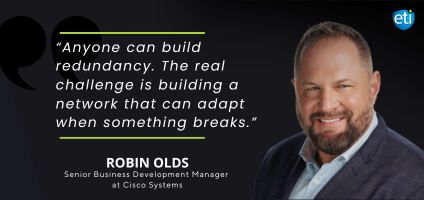
In this episode of The Broadband Bunch, recorded at Mountain Connect 2025, host Brad Hine has a conversation with Robin Olds, Senior Business Development Manager at Cisco Systems. The discussion explores how broadband networks must evolve to support AI-driven applications, rising bandwidth demands, and the next phase of rural and community connectivity.
This episode offers a look at how service providers can future-proof their infrastructure, from network architecture to public funding and digital equity.
Why Broadband Networks Must Change Now
Broadband demand is accelerating faster than ever. AI applications, cloud computing, streaming platforms, gaming events, and real-time collaboration tools are placing unprecedented strain on access and core networks.
Robin explains that service providers are no longer planning for incremental growth. Instead, they are rethinking architecture entirely to handle sustained capacity increases, lower latency requirements, and more dynamic traffic patterns driven by AI workloads.
Key drivers include:
-
AI-generated content and inference workloads
-
Edge computing and real-time applications
-
Major streaming and live-event traffic spikes
-
Long-term growth in residential and enterprise usage
Routed Optical Networking and Network Convergence
A central theme of the conversation is Cisco’s approach to simplifying and modernizing broadband infrastructure through routed optical networking.
Traditionally, service providers deployed separate platforms for optical transport, Layer 2 switching, and Layer 3 routing. Robin outlines how these layers are now converging into fewer, more efficient systems that reduce cost, space, power consumption, and operational complexity.
By consolidating Layer 1 and Layer 3 functions and minimizing Layer 2 dependencies, providers gain:
-
Faster rerouting and recovery during outages
-
Lower latency and jitter
-
Reduced equipment footprints
-
Improved scalability for future bandwidth demands
This architectural shift is especially valuable for rural and mid-sized providers seeking cost-effective ways to expand capacity without overbuilding.
Routed PON: Rethinking Passive Optical Networks
Cisco’s reentry into passive optical networking takes a different approach than traditional PON deployments. Robin explains how routed PON enables providers to deploy PON functionality using pluggable optics rather than large, dedicated chassis.
This allows a single compact device to serve dozens—or even hundreds—of homes while reducing power, cooling, and space requirements. For providers passing small clusters of homes or expanding incrementally, this flexibility can significantly improve return on investment.
AI’s Impact on Broadband Operations and Capacity
AI is reshaping broadband in two critical ways: network operations and user demand.
On the operations side, AI enables predictive analytics, automated remediation, and smarter traffic management. Networks can identify congestion, detect failures, and make corrective changes faster than human-driven processes alone.
On the demand side, AI applications are consuming a growing share of network capacity. Robin notes that AI traffic is rapidly becoming one of the largest contributors to backbone utilization, rivaling traditional sources like streaming and gaming.
To meet these demands, providers must:
-
Increase backbone speeds to 400G and beyond
-
Push compute closer to the network edge
-
Design networks for resilience, not just redundancy
Preparing for the AI Era with Edge Computing
Latency matters more than ever. Robin emphasizes that moving data centers closer to users reduces delays, improves performance, and enhances user experience—especially for AI-driven services.
Edge computing plays a critical role in supporting applications such as:
-
AI inference and content generation
-
Real-time collaboration and communications
-
Interactive media and gaming
-
Enterprise and public sector services
By shifting workloads closer to subscribers, service providers can deliver faster, more reliable experiences while reducing strain on centralized infrastructure.
Broadband Funding and the Digital Divide
The episode also highlights Cisco’s involvement in helping providers navigate federal and state broadband funding programs. Robin discusses initiatives such as BEAD, ReConnect, CAF, and other programs designed to expand access in underserved areas.
Smaller providers, municipalities, tribal nations, and rural operators often need guidance understanding how these funds can be applied effectively. Cisco works with these groups to align technology strategies with funding requirements and long-term network sustainability.
Supporting Rural and Tribal Broadband Providers
Robin shares insights into Cisco’s work with tribal broadband initiatives, where deployment strategies must respect cultural and geographic considerations. In many cases, fixed wireless access complements fiber deployment, offering connectivity without disrupting sensitive land areas.
The conversation reinforces that there is no one-size-fits-all solution. Fiber, fixed wireless, and satellite technologies each play a role in closing connectivity gaps, depending on terrain, population density, and community needs.
Building Resilient Networks for the Future
Robin underscores a key distinction: redundancy alone is no longer enough. Modern broadband networks must be resilient—capable of adapting dynamically to failures, congestion, and changing traffic patterns.
By embracing Layer 3 routing, AI-driven operations, and converged architectures, service providers can improve reliability, control costs, and deliver better subscriber experiences.
Final Takeaway
This episode of The Broadband Bunch offers a clear message for service providers: the future of broadband depends on smarter architecture, AI readiness, and strategic investment. As demand accelerates, those who modernize now will be best positioned to serve communities, compete effectively, and support the next generation of digital innovation.
© 2026 Enhanced Telecommunications.