The following summary has been condensed for length and readability. To listen to the full discussion, click . This episode is sponsored by and .
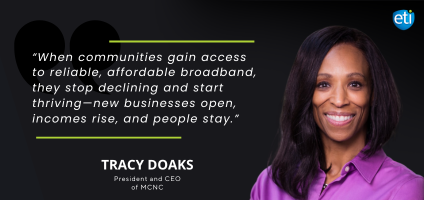
In this episode of The Broadband Bunch, host Pete Pizzutillo welcomes Tracy Doaks, President and CEO of MCNC, for a discussion on broadband deployment, middle-mile strategy, cybersecurity, and the future of digital equity in North Carolina. As one of the most influential broadband leaders in the U.S., Tracy offers a holistic view of how infrastructure, investment, and community partnerships shape outcomes for rural America.
From State CIO to MCNC CEO: A Leader Shaped by Public Service
Tracy begins by sharing her professional journey, which spans engineering, private sector roles, nonprofit leadership, and two decades in North Carolina state government. Her tenure as Deputy State CIO and later State CIO gave her visibility into statewide connectivity challenges—from how schools operate digitally, to the needs of healthcare networks, to how infrastructure impacts economic recovery.
Her personal background plays a role as well. Growing up in rural Virginia, she experienced firsthand how a single industry can define a community—and how its absence can destabilize one. When broadband adoption enables modern jobs, education, and healthcare, she sees a direct link to preventing those declines.
That foundational mission of community impact led her to MCNC.
What MCNC Does and Why It Matters
MCNC—originally called the Microelectronics Center of North Carolina—has evolved far beyond its name. Also known as the operator of NCREN (North Carolina Research and Education Network), MCNC is responsible for connecting:
MCNC currently manages approximately 5,000 miles of fiber, much of it in rural areas where private providers have historically under-invested.
This extensive middle-mile footprint enables smaller last-mile providers to connect households affordably—creating an ecosystem where competition, diversity of providers, and local service innovation can emerge.
Why Middle-Mile Investment Must Continue
Tracy explains that middle-mile infrastructure is the backbone that allows rural communities to scale connectivity.
Last-mile providers often cannot justify building both middle-mile and residential networks. When a middle-mile network already exists and can be leased, rural broadband suddenly becomes viable.
MCNC recently received federal support for a $19-million middle-mile expansion, designed specifically to prime underserved regions for BEAD funding. While recent changes have slowed parts of BEAD rollout, MCNC is committed to ensuring long-term pathway readiness.
Economic Growth Directly Correlates to Broadband Adoption
Tracy points to validated industry research showing that communities with high broadband adoption rates experience:
-
44% higher GDP growth
-
18% higher annual per-capita income growth
-
213% growth in net new businesses over time
-
10% higher self-employment rates
She highlights real examples where broadband access has:
-
Enabled remote healthcare
-
Created tourism-based economies
-
Helped farmers access commodity data in real time
-
Enabled small businesses to digitize operations
-
Allowed remote or hybrid work in places where it was previously impossible
When broadband infrastructure reaches a community, its identity transforms from stagnant to competitive.
Cybersecurity: The Silent Priority
Tracy is direct in stating that cybersecurity is still widely misunderstood and underfunded.
She identifies key threats affecting institutions:
-
Ransomware
-
Network infiltration
-
Data theft
-
Social engineering
-
Identity-based attacks
MCNC provides educational services, threat monitoring, and advisory support—especially to school districts—and pushes for cybersecurity awareness as foundational to digital equity.
Connectivity without security, she notes, creates risk rather than opportunity.
Resiliency and Disaster Recovery Must Be Reimagined
Hurricane Helene was a turning point. The disaster wiped out both aerial and buried fiber, revealing vulnerabilities in traditional redundancy strategies.
Tracy stresses the need for:
-
New restoration models
-
Faster multi-provider emergency coordination
-
Exploration of low-orbit satellite in emergency response
-
Collaboration with utilities
-
Intentional statewide emergency design—not reactive problem-solving
She believes that future broadband resiliency planning must begin now—not when the next disaster occurs.
Utilities and Co-Ops—A Rising Force in Access
Electric membership cooperatives are uniquely positioned to accelerate last-mile deployment because:
-
They already serve rural territories
-
They have trusted community relationships
-
They have infrastructure and service access footprints
-
They’re mission-driven rather than profit-driven
MCNC’s partnership with Roanoke Cooperative’s subsidiary (FYBE) has already proven a scalable model.
Looking Ahead: AI, Data Centers, Workforce Growth, and Investment Models
Tracy makes two predictions:
-
Rural regions may become attractive AI hub anchors, especially as cost pressure makes coastal tech growth expensive.
-
Providers must rethink long-term sustainability models independent of federal funding cycles.
Her closing message is that relying solely on government subsidies is no longer realistic. Future advancement will require shared responsibility between:
-
Private investors
-
Education systems
-
Local government
-
Technology partners
-
Utilities
-
Community organizations
Because broadband is not simply about access—it is about generational transformation.
© 2025 Enhanced Telecommunications.