The following summary has been condensed for length and readability. To listen to the full discussion, click . This episode is sponsored by and .
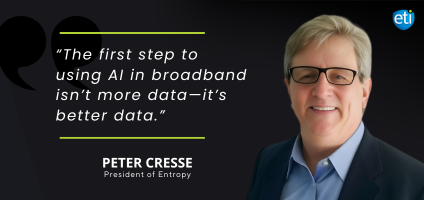
In this episode of The Broadband Bunch, host Brad Hine is in conversation with Peter Cresse, President of Entropy, a technology advisory firm focused on helping executives answer complex technology questions quickly and pragmatically.
The discussion centers on how artificial intelligence is beginning to reshape broadband networks, why providers are still early in the adoption curve, and what steps ISPs should take today to prepare for what comes next.
Why AI Is Gaining Momentum in Broadband
AI is rapidly climbing the agenda at broadband conferences, boardrooms, and executive strategy sessions—and for good reason. As Peter explains, the industry is moving beyond basic machine learning toward deeper AI models built on training and inference.
While many professionals first encounter AI through tools like ChatGPT, Peter emphasizes that enterprise and network AI is fundamentally different. In broadband, AI’s value lies in improving network efficiency, reducing operational burden, and enabling faster, smarter decision-making.
According to Peter, the industry is still early—“the second inning”—but the foundational work happening now will determine which providers gain long-term advantage.
Where Broadband Providers Should Start with AI
Rather than attempting sweeping transformations, Peter advises providers to start with focused, high-impact use cases. The most immediate opportunities include:
-
Predictive maintenance to identify failing network components before outages occur
-
Fault tolerance and alarm reduction to reduce operational noise
-
Quality of experience monitoring across access networks
These use cases save time, reduce costs, and directly improve customer experience—making them ideal entry points for AI adoption.
Data Centers, Fiber Density, and Where the Money Is
Peter describes data centers as one of the most important economic drivers of AI adoption. AI workloads require massive investments in:
As broadband providers expand XGS-PON and multi-gigabit networks, they are laying the groundwork not only for residential services but also for the data center ecosystem that AI depends on.
AI in the Home: Security, Telehealth, and Latency
Peter also highlights how AI-enabled broadband will change life inside the home. With 1–10 Gbps connections becoming more common, the next frontier is not just throughput—but latency.
AI-driven networks are increasingly focused on reducing round-trip delays, which unlocks new use cases including:
AI plays a critical role in managing network efficiency to support these latency-sensitive services.
Data Strategy Comes Before AI Strategy
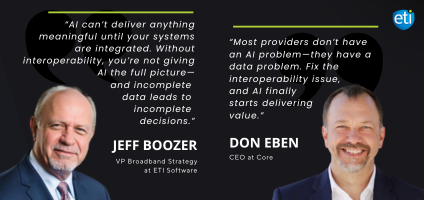
Data readiness is an important theme is this episode. Peter challenges the common belief that simply aggregating data into large data lakes is enough.
Instead, AI depends on:
-
High-quality, well-understood individual datasets
-
Clear metadata and data products
-
Selective learning, not indiscriminate aggregation
Modern AI models rely on techniques like retrieval-augmented generation (RAG), where specific datasets are queried and learned from dynamically. This allows providers to ask targeted questions of their network without moving or duplicating massive volumes of data.
Integration in the Age of AI
Traditional system integrations remain important—especially across OSS and BSS—but Peter explains that AI changes how data is accessed.
Rather than forcing all data into a single system, AI models can:
This approach reduces complexity while enabling more flexible, intelligent automation.
Trust, Security, and the Human in the Loop
AI does not eliminate the need for humans—in fact, it depends on them. Peter stresses that trust comes from boundaries:
-
Public, non-sensitive data can be used with open models
-
Proprietary network performance data must remain private
-
Providers should build and control their own AI models for competitive advantage
Most importantly, AI should assist, not replace, network teams. By removing low-level noise and repetitive tasks, AI allows humans to focus on higher-value work that improves service quality.
Real-World Impact: Reducing Alarm Fatigue
Peter shares an example that involves a network support professional overwhelmed by thousands of alarms. With AI assisting in classification and prioritization, she could interact with her network using natural language—dramatically reducing workload and stress.
This kind of targeted, task-specific automation illustrates how AI delivers value today—not in theory, but in daily operations.
We’re Only in the Second Inning
When asked to place AI on a baseball timeline, Peter calls it the second inning. The industry has seen early glimpses of what’s possible, but the biggest changes are still ahead—particularly with the rise of AI agents that will automate defined tasks across networks.
The advice for providers is clear:
Final Thoughts
This episode offers a practical look at AI in broadband—cutting through hype to focus on what actually works. Peter Cresse’s perspective combines deep technical experience with real-world pragmatism, making this conversation essential listening for ISPs, WISPs, and network operators planning for the next phase of AI-driven broadband.
© 2026 Enhanced Telecommunications.